


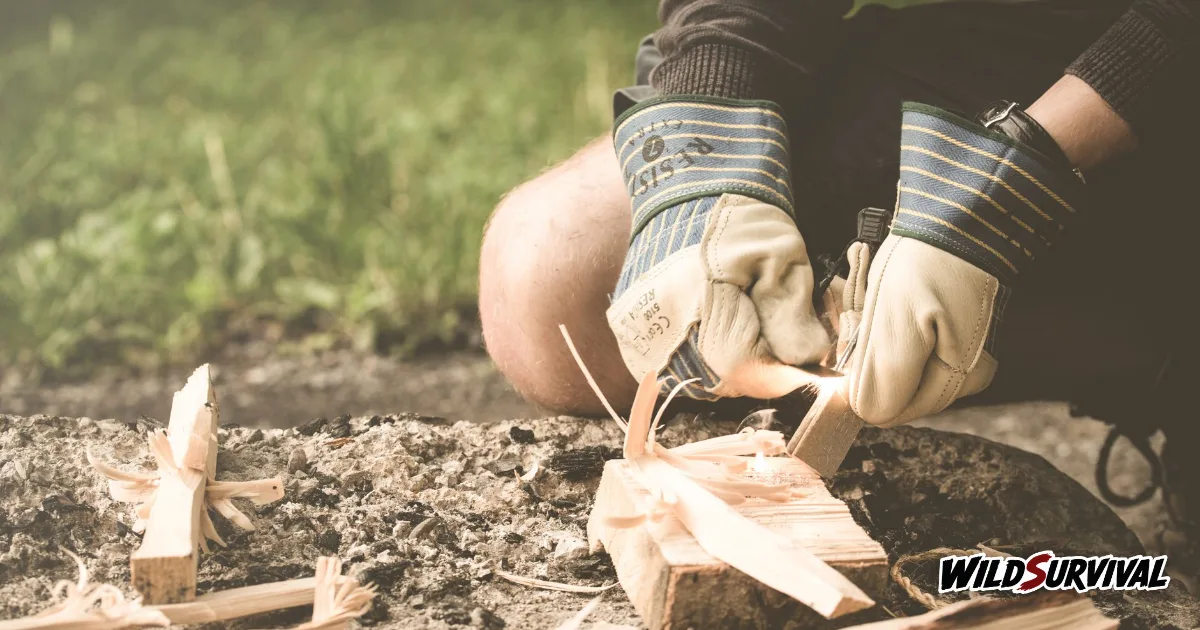
Fatwood is pine wood saturated with resin, found in old stumps, roots and the joints of large branches on dead trees. You can tell it by its weight, its golden-orange to reddish-brown colour and its strong smell of pine. Scraped into fine dust, it catches the spark from a ferro rod, and because the resin sheds water it still lights on days when everything else in the woods is damp.
What fatwood is and how it forms
The British bushcraft instructor Paul Kirtley describes it in his guide to fatwood as resin-saturated heartwood found in certain conifers, particularly pines. The resin collects in stumps, roots or old branch junctions, usually after a tree dies, is damaged or is felled, and over time it concentrates in the wood that remains.
Kirtley writes that all pines can produce it, and he names Scots pine, which grows right across Eurasia, among the sources. He also makes the point that it does not form in every conifer. In Britain, that puts old, dead Scots pine at the top of your search list.
Where to look for fatwood
Kirtley lists four places worth checking. Start with the trunk of a pine that has died and is still standing. Next comes the base of an old stump, where you chip into the wood with an axe to reach the heart. Then look at the junctions where a big limb meets the trunk, and finally at dead lower branches still hanging on the tree. Pines brought down by a storm deserve a look as well, since Kirtley links the build-up of resin to trees that have died, been damaged or been felled.
He draws a clear line on what you take: wood from dead trees or fallen limbs only, and never a cut into green, living wood. Keep that rule in mind on every walk, and note the dead pines you pass, so you know where to ask for permission later.
More articles on WildSurvival
- Tent Condensation: Why It Forms and How to Reduce It
- Tour du Mont Blanc: Route, Huts and Wild Camping Rules
- How to Wash and Reproof a Waterproof Jacket
Collecting fatwood responsibly in Britain
Dead wood sits on land that someone owns, and it also matters to the woodland. NatureScot’s camping advice in the Scottish Outdoor Access Code asks campers to leave wood on the ground and never cut down or damage trees, because dead wood supports many creatures and the wider ecosystem. The same page says not to light an open fire, including in fire bowls or barbecues, at times of high fire risk, and to keep open flames away from forests, farmland and peaty ground. Where you do need to cook, it suggests a camping stove set on a level, non-flammable surface away from dry grass and vegetation.
So on many trips your fatwood will simply stay in its bag, kept for the night when a fire is allowed, safe and genuinely needed. Treat it as a reserve for wet weather and emergencies.
The simplest approach is to gather your supply at home, from a stump on your own land or with a landowner’s agreement, then carry it with you. On site, follow local fire rules, put out every ember and clear the fire site, as set out in our guide to Leave No Trace principles.
How to identify fatwood: weight, colour and smell
Three checks settle most doubts in the field. Kirtley describes the wood as dense, golden-orange or reddish-brown, and much heavier than an ordinary piece of seasoned pine of the same size. Shave or cut into it and a strong pine scent comes off the blade.
Age changes the feel. Fresh pieces are sticky to the touch, while older ones turn hard and lose that tackiness. The wood also looks darker than the branch material around it, with amber or orange showing inside when you nick it with a knife. A piece that is light, pale and smells of nothing much is ordinary dead wood: still useful as kindling, though it lacks the resin you are after.
Preparing it: scrapings, shavings and feather sticks
Kirtley describes three ways to prepare the wood. Scrapings come first: hold the spine of your knife, or a saw, at a right angle to the wood and scrape until you have a fine dust that will take a spark from a ferro rod. That is the surest starting point with a fire steel, and our guide to choosing a survival fire starter covers how those rods work. A small tin of scrapings prepared at home saves time on a cold, wet evening, when stiff fingers make careful knife work harder.
Shavings are thin slivers that light from a match, or from a spark if they are fine enough. Feather sticks keep the curls attached to the stick, so you can light them and then move them under your kindling. According to Kirtley, feather sticks made from fatwood burn hotter and longer than similar ones carved from ordinary softwood.
Why fatwood burns in wet weather
The resin does the work. Kirtley says the wood burns hot with a long-lasting flame and is difficult to put out once alight, even in wind. Because resin repels water, it remains usable when the rest of your tinder is damp.
That makes it worth carrying on any trip where rain is forecast, when bark and twigs picked up from the ground refuse to catch. Our guide to making fire in the rain explains how to build the rest of the fire around that first flame.
Lighting a fire with it, step by step
Get everything ready before the first strike. Pile a small heap of scrapings on something dry, a strip of bark or a flat offcut, keep the shavings within reach and sort your kindling from the thinnest to the thickest. Once the flame is going, there is no time to hunt for sticks.
Rest the tip of the ferro rod against the heap and strike firmly, sending the sparks into the dust. As soon as it flares, add a few fine shavings and then the feather stick, which Kirtley suggests lighting and then moving under the kindling. Build up gradually from there, twig by twig, and if the first attempt fails, scrape a finer dust and try again.
Fatwood at a glance
| Step | What to do |
|---|---|
| Search | Standing dead pines, old stumps, big branch junctions, dead lower limbs |
| Check | Heavy, orange or reddish-brown, smells of pine, sometimes sticky |
| Collect | Dead wood only, with the landowner’s permission |
| Prepare | Scrapings for the rod, shavings for a match, feather stick to launch the fire |
| Carry | A whole piece in a waterproof bag, scraped when needed |
A hand-sized piece of fatwood slips into a pocket of your pack. Spot the right trees on your walks, ask before you take anything, and practise your scrapings at home before you need them outdoors.