


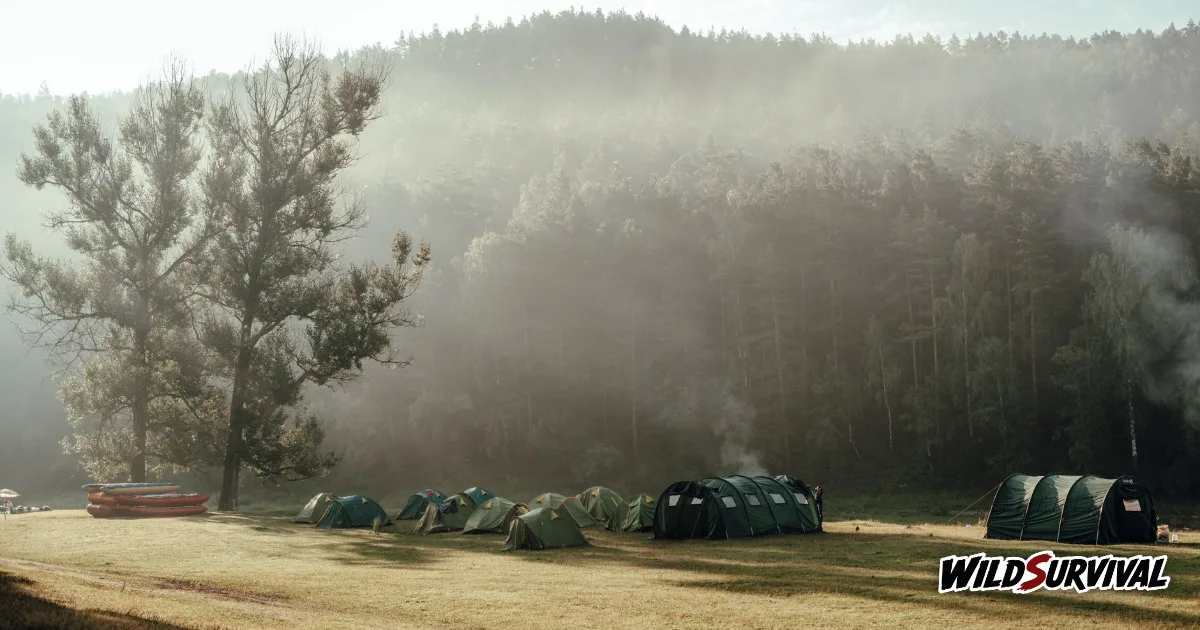
Tent condensation is mostly water you put there yourself: your breath and body heat load the air inside with moisture, and that vapour settles on any fabric colder than the air around it. Keep every vent open, even when it rains, pitch the flysheet taut without overdoing it, and camp in sheltered spots away from lakes and rivers. Those three habits cut down the drips you wake up to, and a microfibre cloth deals with what is left.
What causes tent condensation
The Australian gear maker Sea to Summit gives two reasons in its page on condensation and what you can do about it. The first is the dew point, the temperature at which humidity in the air turns back into liquid water. The second is the moisture from your breath and from any gear drying inside, which condenses as soon as that warm vapour meets the cold canopy.
Decathlon, whose Quechua brand makes a large range of tents, lists the same culprits in its guide to preventing condensation in tents, along with a few more. Warm air trapped during the day, a day of rain, water heated inside the tent, breathing and body heat all add to the moisture. Moisture condenses on the inner face of the flysheet once the fabric is colder than the air inside.
Sea to Summit also points out that dew forms on the grass and on the outer surface of the canopy. A flysheet soaked on the outside at dawn is therefore mostly dew. To judge how much tent condensation you really had, run a hand along the inner face of the fly.
Decathlon makes one reassuring point plainly: a tent covered in condensation keeps its waterproofing, and the water dripping on you in the morning came from the air you slept in.
Ventilation: keeping air moving between fly and inner
Airflow is the strongest tool you have against tent condensation. Decathlon’s advice is to open every vent fully, even in the rain, and to leave a gap between the ground and the bottom edge of the flysheet. That gap lets air enter low and travel up through the tent, carrying moisture out before it settles on the fabric.
Sea to Summit recommends pitching the tent oriented to the wind and opening the vents to get cross-flow ventilation through the night. Check where the breeze is coming from before you peg out, so the vents can do their job.
Inside, keep wet clothing, boots and towels in the porch, the covered area in front of the door, and out of the sleeping compartment. If a damp jacket has to come inside, seal it in a dry bag so its water stays out of the air you breathe. Heating water inside adds vapour too, and Decathlon counts it among the things that make tent condensation worse. A stove burning in an enclosed space also brings the risk of carbon monoxide, which our guide to winter camping on a cold night covers in detail.
More articles on WildSurvival
- Tour du Mont Blanc: Route, Huts and Wild Camping Rules
- How to Wash and Reproof a Waterproof Jacket
- Leave No Trace Principles Applied to Wild Camping
Pitching tension and keeping fabric apart
According to Decathlon, folds in a slack fabric channel water and help droplets form, so the flysheet needs careful tension, just enough pull on the guylines to smooth those folds out. Check that the fly never touches the inner tent once it is pitched, and keep your sleeping bag and mat away from the walls through the night.
Go round the guylines again before you turn in, and once more if you get up in the night, so that the gap between fly and inner holds. The same eye for a taut, well-shaped pitch applies to simpler shelters, as our guide on how to pitch a tarp explains.
Where you pitch changes tent condensation
Your choice of site counts as much as your pitching. Decathlon suggests a shaded spot, because a flysheet open to the sky gives off its heat and cools down. It also advises against camping too close to a lake or a river, and prefers woodland, where temperature and humidity stay steadier.
In practice, expect more tent condensation on a riverbank, on open meadow, or after a day of rain that has left the ground saturated. A good pitch also keeps you out of the worst of the wind and away from dead branches overhead, and our article on choosing a campsite location runs through those checks. When the only flat ground left is close to the water, open every vent and keep the porch door rolled back for as long as the weather allows.
Single-wall and double-wall tents
The design of the tent mainly decides where the water ends up. In a single-skin shelter, Sea to Summit notes, condensation can drip straight onto the people sleeping inside. In a double-wall tent it forms on the inside of the rainfly and runs down it, away from the inner compartment.
For single-skin shelters, Sea to Summit describes ventilation as absolutely essential. If you use one, open every vent from the moment it is pitched and keep a cloth within reach, because the tent condensation sits a few centimetres from your face.
Habits that make tent condensation worse
Read together, the advice from Sea to Summit and Decathlon points to a handful of common mistakes. Each one either adds moisture to the inner tent or stops the air from carrying it away.
- Zipping every vent shut as soon as it rains, when Decathlon asks for them to stay open even in a downpour.
- Boiling water or cooking inside the sleeping compartment.
- Hanging wet clothes inside the inner tent to dry overnight.
- Pitching on the edge of a lake or a river for the view.
Fix those four before you blame the tent. Decathlon describes tent condensation as a natural occurrence, and the way you camp can make it better or worse.
Dealing with tent condensation in the morning
Decathlon recommends wiping the inside gently with a microfibre cloth, without pressing, since pressing hard can push the moisture into the fabric. Then open the door and leave the tent somewhere dry until the inside has dried out, closing it again in the evening.
On a multi-day trip you rarely have that time. Sea to Summit suggests shaking the fabric and draping the canopy over a bush or a branch to dry before you pack it. It also advises packing the rainfly and the tent in separate stuff sacks, as the fly can hold more moisture. Spread everything out again at lunch if the sun comes through, so you are not pitching a damp tent that evening.
| When | What to do | Why it helps |
|---|---|---|
| Choosing a pitch | Woodland, back from lakes and rivers | Steadier temperature and humidity |
| Pitching | Taut fly, no contact with the inner, gap at ground level | Fewer folds, air rising through the tent |
| Evening | Vents open, wet kit in the porch | Less vapour in the inner tent |
| Night | Sleeping bag away from the walls | No contact with damp fabric |
| Morning | Gentle wipe, shake, dry, pack fly separately | Less water carried in your pack |
A cold, damp night will always leave some water on the fly, since every breath adds to it. Keep a microfibre cloth in the inner pocket to wipe off the tent condensation before you pack the flysheet, then dry it out at the first sunny break.