


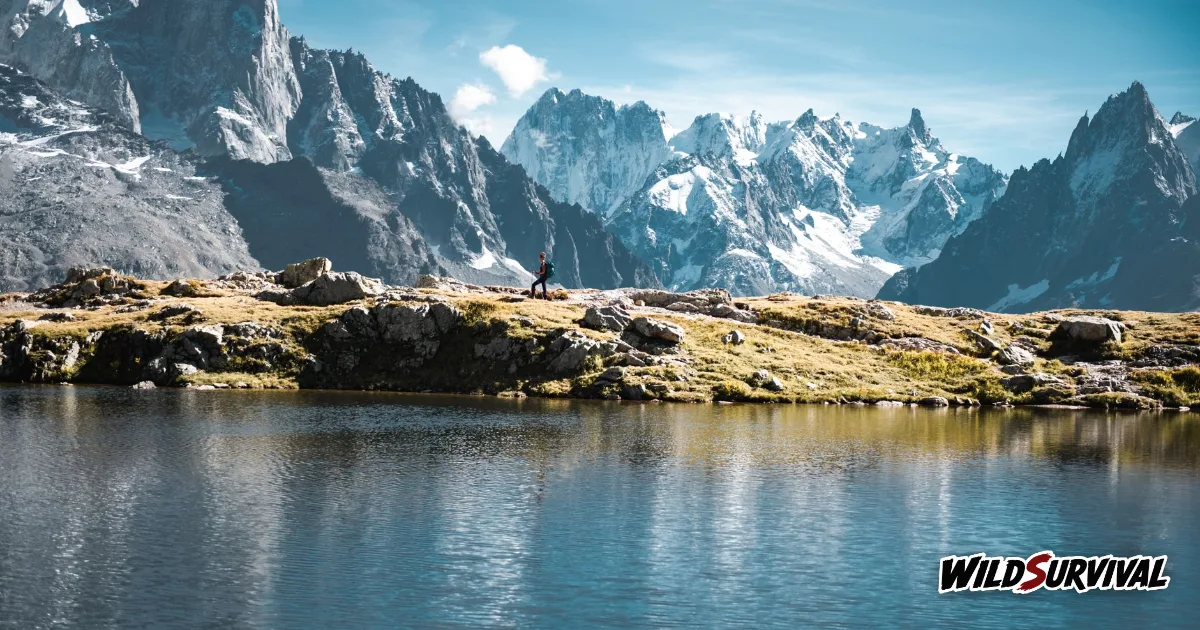
The Tour du Mont Blanc is a loop of roughly 170 km around the Mont Blanc massif, with about 10,000 m of total ascent, and it crosses France, Italy and Switzerland. Most hikers walk it anticlockwise in 10 or 11 stages, sleeping in mountain huts that open from mid-June to mid-September. For July and August, huts can be fully booked months ahead, so booking comes first. Wild camping, meaning a single night in a small tent pitched late and packed away early, is allowed only in specific places, and the rules change at almost every border and valley.
The Tour du Mont Blanc route through three countries
The official route website is run by the association of TMB hut and gîte keepers, and its description runs country by country. In France, the trail passes through the Chamonix valley, Les Houches, Saint-Gervais, Les Contamines-Montjoie and Les Chapieux. In Italy, it drops into Courmayeur by way of Val Veny and then follows Val Ferret. In Switzerland, it runs from La Fouly to Trient via Champex-Lac before heading back into France.
The French Hiking Federation’s page on the GR TMB lists the main passes: Col du Bonhomme, Col de la Croix-du-Bonhomme, Col de la Seigne on the French-Italian border, the Grand Col Ferret between Italy and Switzerland, Col de la Forclaz and Col du Brévent. The federation, known as FFRandonnée, puts the number of people on the trail at between 20,000 and 25,000 a year, and notes that the waymarking was laid between 1950 and 1952.
Those waymarks change at each border. According to the hut keepers’ association, a green “TMB” logo runs around the whole Tour du Mont Blanc. Alongside it you will see the red and white GR stripes in France, yellow markings in Italy, and in Switzerland either yellow signs on walking paths or red-white-red stripes on mountain trails.
Distance, ascent and the usual number of stages
The association’s FAQ gives 170 km and about 10,000 m of ascent for the full loop. FFRandonnée describes it as a 215 km loop from Les Houches, to be walked in ten days. That is a sizeable gap between two serious sources, so measure the exact line you plan to follow, stage by stage, on the map or in your guidebook before you lock in a schedule.
The stage count is more settled. The Tour du Mont Blanc is usually walked in 10 to 11 stages, each one a day between two places to sleep, covering 10 to 20 km with climbs that can top 1,000 m. The association talks about 5 to 8 hours on your feet a day, several days running, and it suggests three paces.
| Pace | Days | Who it suits |
|---|---|---|
| Athletic | 7 | Experienced hikers happy with long days |
| Balanced | 9 to 10 | The most popular option, 15 to 20 km a day |
| Contemplative | 11 to 12 | Shorter stages, families with children over 10 |
More articles on WildSurvival
- Dakota Fire Hole: How to Dig an Underground Campfire
- How Much Water to Drink When Hiking, and When to Drink It
- Walking Time in the Hills: Naismith’s Rule and Its Rivals
Which way round, and where to start
FFRandonnée starts the Tour du Mont Blanc in the village of Les Houches, at the gateway to Chamonix. Its list of key stops follows the most common order: Les Contamines-Montjoie, Les Chapieux, Courmayeur, Champex, Vallorcine and Tré-le-Champ, then back into the Chamonix valley.
That anticlockwise direction is the most popular and the best waymarked, says the hut keepers’ association. You can still walk the Tour du Mont Blanc clockwise, and the association points out that doing so may help you find free beds if your travel dates are fixed.
If you have read our guide to hiking the GR20 in Corsica, the planning will feel familiar: an official direction, nights booked in advance and a route cut into day-long stages. The Corsican trail is even stricter on camping.
When the huts are open
The association places the Tour du Mont Blanc season between mid-June and mid-September, when the passes are clear of snow and the huts are staffed. It warns that patches of old snow can linger through June and into early July. In autumn, the days get shorter, the nights colder, and the summits may already have a dusting of snow.
FFRandonnée sorts walkers into three groups. Some prefer the second half of June, others swear by late September and its still-pleasant days, and many simply have no choice but to go in July or August. Those two summer months are exactly when the association urges you to book earliest.
If your dates are flexible, the shoulder months give you more room in the huts, as long as you can live with some snow in June or chillier nights in September. Opening dates vary from one hut to the next, so check each one as you book.
Booking huts for summer 2027
The association runs a booking platform for the huts and gîtes that belong to it, and anything outside that network has to be booked directly with the owner. Bookings for summer 2027 opened on 15 October 2026 for every hut on the platform. The association calls booking strongly recommended, and essential in high season, when some places on the Tour du Mont Blanc fill up months in advance.
On cost, it quotes €65 to €95 a night for half board in a dormitory, and between €500 and €900 for a trek of 7 to 10 days. Hut life follows a set rhythm: arrival usually between 4 pm and 6 pm, dinner around 6:30 or 7 pm, and lights out at about 10 pm.
Read the cancellation terms before you pay the deposit. The FAQ explains that a booking can be changed up to 30 days before arrival. Cancel more than 30 days out and you get 80% of the deposit back, while inside 30 days there is no refund at all, unless you took out cancellation and trip interruption insurance that covers your reason.
Wild camping rules in France, Italy and Switzerland
On the Tour du Mont Blanc, the rules for a night in a tent shift from one commune to the next, and the association’s bivouac page sets them out place by place. In Chamonix, camping and bivouacking are banned apart from high-altitude bivouacs between sunset and sunrise, and some spots are closed to overnight stays altogether: Lac Blanc, Montagne de Chailloux, the Blaitière pastures and Col des Posettes. The Carlaveyron, Aiguilles Rouges and Vallon de Bérard reserves require advance booking.
In Les Houches and Saint-Gervais, a bivouac is tolerated for one night, from sunset to sunrise. In Vallorcine, outside the reserves, you may stay one night from 7 pm to 9 am with the landowner’s permission, which is granted automatically above 1,700 m. Around Bourg-Saint-Maurice, the commune that covers Les Chapieux, bivouacking is off limits because the land is private property and alpine pasture.
Les Contamines-Montjoie nature reserve brought in a tougher regime this year. Prefectural order no. DDT-2026-0474, signed on 4 June 2026 by the Prefect of Haute-Savoie, bans bivouacking from 15 June to 15 September in all zones below 2,500 m and in sensitive areas marked red on its map. Camping stays tolerated from 7 pm to 9 am at the Pont de la Rollaz area, capped at 40 tents, at La Balme, capped at 50 tents, and outside the red zones. Swimming in the lakes is banned all year, dogs included. The order runs until 31 December 2026, so check the rules for the following season before you go.
On the Italian side of the Tour du Mont Blanc, in the Aosta Valley, the association says wild camping is banned in every form and bivouacking is forbidden below 2,500 m, with a fine of €566. In the Swiss canton of Valais, bivouacking is generally prohibited, with exceptions for a single night, outside a group, above the tree line or in an emergency, and camping belongs on official campsites. For the general French picture, our guide to wild camping rules in France and its parks fills in the background.
A 90-day training plan
FFRandonnée rates the Tour du Mont Blanc as a mid-mountain hike within reach of any trained walker. The association gives a clearer benchmark: you should be able to walk for 6 hours with 1,000 m of ascent carrying a pack, then lace your boots up again the next morning. It reckons three months of steady preparation will get you there.
| Time before departure | The association’s plan |
|---|---|
| Day 90 to day 60 | Two outings a week, one of them uphill, 2 to 3 hours, without pushing |
| Day 60 to day 30 | One long weekly walk of 4 to 5 hours with 800 to 1,000 m of ascent and a 6 kg pack |
| Day 30 to day 10 | A test weekend of two back-to-back days with your real pack and trekking boots |
| Day 10 to departure | Cut the volume, sleep well, try nothing new |
Keep that test weekend in the diary, because it is the only point in the plan where you string two loaded days together, as you will on the trail. To work out how long your training walks will really take with the climbing, our piece on walking time and Naismith’s rule helps you build outings that look like real stages.
Packing a 35 to 45 litre rucksack
The association recommends a 35 to 45 litre pack weighing 8 to 12 kg at most, boots that are already worn in, a waterproof jacket and a three-layer clothing system. It also suggests trekking poles and a silk sleeping bag liner for the dormitories. Its training guide adds a rule of thumb: keep the pack below roughly 20% of your body weight. Two downloadable checklists on its site cover hut nights and bivouac nights.
Plan for gaps in coverage on the Tour du Mont Blanc too. There is no mobile signal between the Pont Romain at Les Contamines and Lac Combal on the Italian side. The association reminds walkers that 112 works in all three countries, which only helps once you are back in range.
Walking with a dog takes extra planning. You need to check with each hut and carry the dog’s food, dogs are banned from the Les Contamines-Montjoie and Chamonix valley reserves, and cable cars along with some shuttles, notably at Les Chapieux, usually refuse them.
Buses, trains and shorter versions of the loop
The association notes that the Tour du Mont Blanc has several variants. Some add more technical ground and high views, while others take the edge off certain stages. Pick them when you book, since a variant can change where you sleep.
Public transport lets you skip a wet day, shorten a stage or get back to your start. In France, the Martigny to Le Fayet railway serves Chamonix, Les Houches and Saint-Gervais, the Y84 bus links Sallanches with Les Contamines-Montjoie, and shuttles run up to Les Chapieux from Bourg-Saint-Maurice. In Italy, free shuttles leave Courmayeur for Val Veny and Val Ferret, and a bus connects Courmayeur with Chamonix through the Mont Blanc Tunnel. In Switzerland, buses serve La Fouly and Champex, and the Champex to Martigny connection joins the Swiss rail network.
With those links, you could walk as far as Courmayeur, ride the tunnel bus back to Chamonix and save the Swiss section for another trip. Check the current year’s timetables before you rely on a shuttle.