


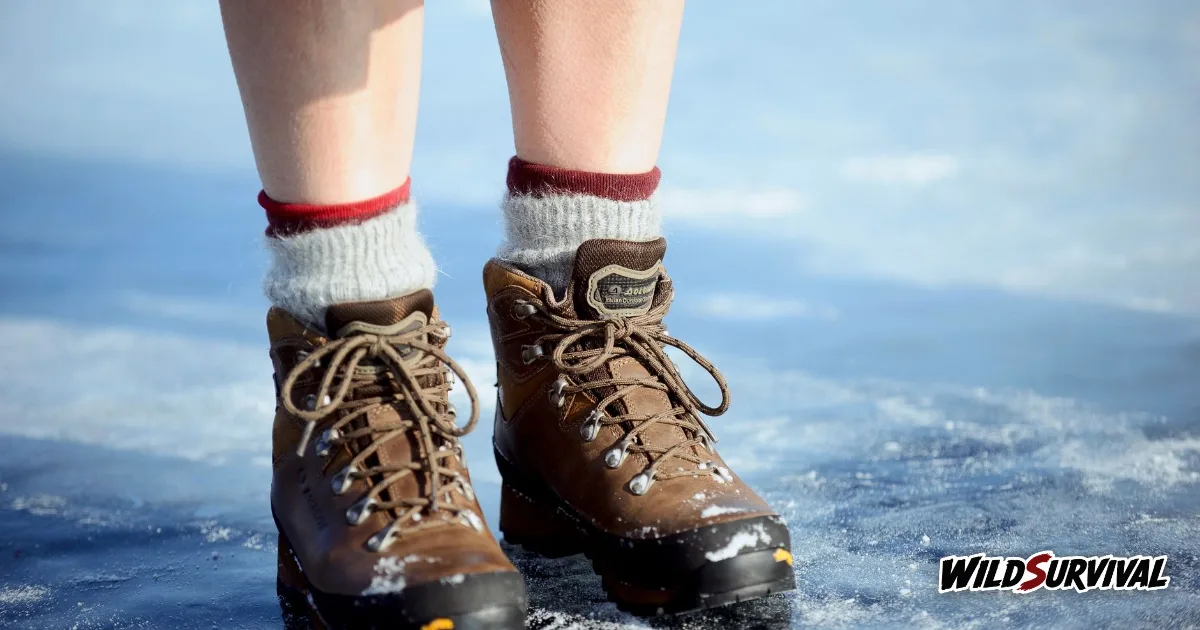
Microspikes are short spikes joined by chains that you fit over an ordinary, flexible walking boot to stay upright on icy paths and packed snow. They belong on gentle ground: Mountaineering Scotland describes them as designed for icy paths and tracks with low-angle inclines, typically 15 to 20 degrees at most. On steeper, technical or mixed ground, where a slip could turn into a serious fall, you need proper crampons. The right choice starts with the terrain, then comes down to your boots and the length of the spikes.
What microspikes are, and what makes them different
In his buyer’s guide to the Kahtoola range, Andrew Skurka sets out the specification of the brand’s MICROspikes: twelve 3/8-inch spikes, which is 9.5 mm, and a weight of 12 oz, about 340 g, give or take depending on the size, across four sizes. He calls them very effective on ice and compacted snow. He wrote the guide in January 2018 after talking to Kahtoola about the differences, intended uses and limitations of its models, and he states that he has no financial ties to brands. He also rates this model as compact and quick to put on and take off. The lighter NANOspikes from the same brand work well on pure ice, he adds, but struggle in any snow. They work with soft-soled boots and shoes, and unlike conventional crampons they need no stiff sole or special heel piece.
The mountain brand Salewa adds a useful point in its guide to choosing crampons: microspikes are not regulated by any standard. Their shorter points make them easier to walk on, and Salewa recommends them for less extreme conditions, such as the short stretches of snow you may meet on a trail.
The 15 to 20 degree limit for microspikes
Mountaineering Scotland, which represents around 16,000 individual and club members and 150 affiliated clubs, set out its position in a post published on 28 January 2025 on the Mountain Weather Information Service blog. It describes microspikes as lightweight and cheaper traction devices, built for icy paths and tracks at low angles, and largely unsuitable for steep or technical terrain. Crampons are sturdier and give the grip you need on steep, technical or mixed ground.
Ross Cadie, the organisation’s Mountain Safety Advisor, warns that the misconception that microspikes and crampons are interchangeable can put people at serious risk in the mountains in winter. He describes Scotland’s winter mountains as beautiful but unforgiving, and in his words, the right equipment and skills can mean the difference between a great day out and a dangerous situation.
The post draws on a survey of more than 1,300 walkers and climbers carried out at the end of the previous winter. Most experienced respondents knew when each tool was appropriate, while a notable share of less experienced hikers did not know the key differences. 83% use both microspikes and crampons, 17% rely on them alone, mainly on defined paths and tracks, and 90% of those who use them prefer spikes to coils. Many respondents also complained about misleading or incomplete advice on social media.
Its four recommendations are straightforward: understand what each tool can and cannot do, choose by terrain, take a winter skills course that also covers the ice axe, and rely on trusted sources for your information. The organisation runs this work with Scottish Mountain Rescue, Mountain Training, Glenmore Lodge and the Scottish Avalanche Information Service.
More articles on WildSurvival
- Tent Condensation: Why It Forms and How to Reduce It
- Tour du Mont Blanc: Route, Huts and Wild Camping Rules
- How to Wash and Reproof a Waterproof Jacket
Matching your traction to the ground
Andrew Skurka points to the other end of the problem. In unconsolidated snow, such as soft spring snow, the 3/8-inch spikes reach their limit and stop giving reliable purchase. His own examples, all from the United States, show the ground they suit. He notes that nearly every trail runner around Boulder owns a pair, since running or hiking the icy foothill trails there in winter is risky or impossible without them. He cites them on the Wind River High Route, which involves non-technical glacier travel, and on early-season stretches of the Pacific Crest Trail and the John Muir Trail, for instance following boot tracks up to a 12,000-foot pass, about 3,660 m, early in the morning. He finds them sufficient on the John Muir Trail in most years. The Sierra High Route can be done with them, but with steeper ground and no boot tracks to follow, they would not be his first choice.
Salewa describes its universal strap-on crampons as suited to travel on horizontal ice or occasional slight slopes, though they are not stable enough for extremely steep ground. For full crampons, the brand recommends steel on ice and rock, since it is more robust and durable, and aluminium on snow, where the lower weight pays off. Ten-point crampons are designed for compact snow, and twelve points or more for glaciers and frozen walls.
| Ground | Traction | Why |
|---|---|---|
| Icy path, packed snow, gentle gradient | Microspikes | Light, short points, any flexible boot |
| Soft, unconsolidated snow | Longer spikes | 3/8-inch spikes lose reliable purchase |
| Horizontal ice, occasional slight slope | Universal strap-on crampons | Fit any boot, unstable on very steep ground |
| Steep, technical or mixed ground, glacier | Full crampons with ice axe | Grip where a slip could mean a serious fall |
If your winter walk turns into a night out, our guide to winter camping in serious cold covers the rest of the kit.
Boots, sizing and fit checks
Microspikes suit the flexible boots most walkers already own, according to Skurka. Crampons are fussier. Salewa ties each binding to the boot: automatic step-in crampons need a proper welt at the front and back, semi-automatic ones only need a heel welt, and universal strap-on models need no welt at all and go on any boot. The rigidity of the sole matters too. Our comparison of Salomon, Merrell and Lowa hiking boots can help if you are choosing a pair for winter.
Salewa asks you to check the position of the straps before every use and to test the fit by standing on the crampons and turning your foot. On automatic bindings, make sure the heel clicks firmly into place.
Kahtoola’s K-10 comes in a single size which, according to Skurka, fits men’s hiking boots from US size 6 to 13 and women’s from 7 to 14. Trail shoes can go slightly larger and big boots the other way, and the brand supplies an XS or XL LeafSpring Flex Bar on request for feet outside that range.
Spike length, from icy paths to steeper snow
Skurka compares three Kahtoola models, and spike length tracks the terrain. The MICROspikes carry twelve 3/8-inch spikes. The K-10 crampons step up to ten 3/4-inch spikes, about 19 mm, weigh 21.5 oz, about 610 g, and bite better in softer snow and on steep-ish slopes, though they are almost twice as heavy and slower to put on and take off. Skurka calls the K-10 the more appropriate pick for most early-season backpacking, especially off established boot tracks, and says he will take it up slopes of about 45 degrees, while admitting his tolerance is probably higher than most people’s. On compacted snow and ice its spikes grip as well as the shorter ones, but it is less comfortable, which is why he calls it overkill for the Boulder foothills and for the John Muir Trail in most years. The KTS, Kahtoola’s original product, is slightly more capable, with ten 1-inch spikes and a more engineered heel piece, and weighs 23.3 oz, about 660 g; he finds it excessive for nearly all backpacking and better suited to lightweight mountaineering.
Short spikes cover packed paths, longer spikes help when the snow softens or the slope steepens a little, and full crampons take over once the ground becomes properly steep, icy or technical.
Cleaning, drying and storing your traction
Salewa’s care advice is written for crampons. Wash them in warm water and rinse with clean water, at 30 degrees at most, then leave them to dry at room temperature. Never store them close to a heat source, and keep them away from corrosive chemicals.
With no standard covering microspikes, read the manufacturer’s instructions for your pair to know its limits of use before the first outing.
What to pack for your winter walk
| Your walk | What to take |
|---|---|
| Frozen forest track, packed path at a gentle angle | Microspikes |
| Softer snow, slightly steeper trail | Longer-spiked traction such as hiking crampons |
| Steep, icy, technical or mixed ground | Full crampons, an ice axe and the training to use both |
Before you buy, look at the map of your route and find the steepest sections, the ones where a slip would matter. If the whole walk stays on paths at a gentle gradient, microspikes will do the job. As soon as a section goes beyond the 15 to 20 degree limit quoted by Mountaineering Scotland, or crosses hard ice, take crampons and the skills to go with them.