


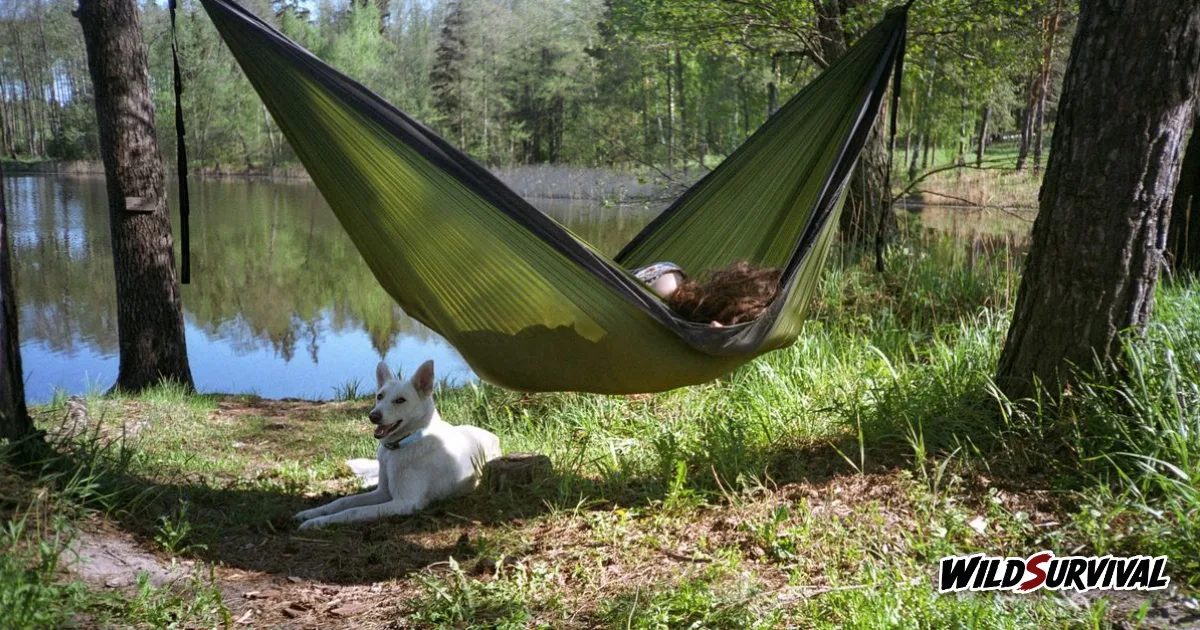
A hammock underquilt is a quilt that hangs below the hammock, outside the fabric, to insulate your back where your sleeping bag gets crushed under your weight. Once nights turn cool, it is the piece of gear that decides whether you sleep warm or wake up with a cold back. For winter, pick a full-length hammock underquilt rated at least as low as the coldest night you expect, and adjust it so it touches the hammock along its whole length.
Why a hammock gets cold from below
In a hammock, you are surrounded by air. The insulation in your sleeping bag, pressed between your back and the fabric, loses its loft, and loft is what holds warmth. The Polish down maker Cumulus sums it up on its underquilt page: the underside of a hammock is exposed to cold air, and an underquilt puts insulation exactly where it is missing.
Ground sleepers tend to reach for a sleeping pad. Hammock maker Warbonnet explains that a pad set under the hammock fits badly and lets heat escape. If you use a pad at all, it should go inside the hammock, under your back or between the layers, and never between the underquilt and the hammock fabric. If you are new to all this, our piece on the camping hammock covers the rest of a suspended sleep system.
The underquilt sidesteps the problem because it hangs outside. Your weight rests on the fabric, and the quilt stays lofted just beneath it, uncompressed. Section Hiker compares it to the sleeping pad of someone who sleeps on the ground: it keeps your underside warm in the same way, while the hammock body does the job of holding you up.
Full-length or 3/4 hammock underquilt
Every maker gets this question. The backpacking site Section Hiker devotes a guide to full-length versus 3/4 underquilts to it. A 3/4 model insulates your back and butt and leaves your lower legs and feet uncovered, since they need less insulation, especially in mild weather.
Temperature settles it. According to Section Hiker, if nights stay at 40 to 50 °F or warmer, you can usually get by with a 3/4 hammock underquilt, letting your top quilt or sleeping bag cover your lower legs, with a short foam pad under your feet if needed. Below 40 °F, most people go for a full-length hammock underquilt that insulates the feet too.
The 3/4 has another drawback: it takes more adjusting to cover your torso and butt every time you hang. If you slide down in the hammock or move around a lot, expect a cold spot by morning. A full-length model covers more of the hammock, so you can shift around and stay warm. It weighs more and packs bigger, though Section Hiker notes that lighter goose down and fabrics can offset part of that penalty. Many hangers end up owning two quilts, a 3/4 for warm months and a full-length one for the cold. If you can only afford one hammock underquilt and plan to keep hanging into late autumn, the full-length version is the safer buy, since it covers the cold nights a 3/4 cannot and still works on mild ones.
Warbonnet offers a middle route with its Yeti, a torso-length quilt 40 inches wide and 46 inches long, from shoulders to knees. For 0 °F and below, the company recommends adding a short leg pad, foam or inflatable, which many people skip in summer. Warbonnet says this split saves about 7 to 8 ounces compared with a full-length quilt plus a small sit pad, and that in an emergency, stacking the leg pad under your torso adds at least 25 degrees of extra warmth.
More articles on WildSurvival
- Paracord 550 Uses: The Mil-Spec Cord in Camp and Its Limits
- Treating Burns Outdoors: Cool, Cover and Call for Help
- Avalanche Risk Snowshoeing: Bulletins, Kit and Safe Routes
Temperature ratings from the makers
Hammock underquilt ratings vary from brand to brand, and few companies explain how they arrive at them. Here is what three makers publish on their product pages:
| Model | Ratings offered | Fill | Notes |
|---|---|---|---|
| Hammock Gear Incubator | 40 °F down to 0 °F, in 10 °F steps | 850-fill down | full length, three sizes from 5’2″ to 6’7″, draft collars at both ends |
| Warbonnet Yeti | 40 °F, 20 °F, 0 °F | 850-fill DWR down | torso length, leg pad advised in deep cold |
| Cumulus Selva | comfort from 9 °C to -14 °C by model | 850-fill down, 120 to 600 g | total weight 250 g to 920 g |
At Cumulus, the link between fill and rating is easy to read: the Selva 120, with 120 g of down, is rated comfortable at 9 °C, the Selva 450 at -6 °C and the Selva 600 at -14 °C for 920 g all in. Hammock Gear lists packed volume instead, about 4.5 liters for the 40 °F Incubator and 8.5 liters for the 20 °F version, with a 7D, 10D or 20D ripstop shell treated with DWR. Its listed base price is $219.95, before temperature and length upgrades.
Warbonnet attaches conditions to its ratings: wind blocked by a tarp or a hammock sock, the quilt fluffed evenly, warm top insulation including a hat, and a leg pad in cold weather. The company also warns that cold sleepers may fall short of the numbers. Keep a few degrees of margin below the rating.
The Cumulus range also shows that two quilts with the same rating can differ in weight. The Selva 250 and the Selva 300 are both rated comfortable at 2 °C, at 480 g and 575 g respectively, so read the fill weight as well as the temperature when you compare one hammock underquilt with another. Packed size matters too in a winter pack already full of layers, which is why Hammock Gear bothers to publish it.
Hanging and adjusting a hammock underquilt
A hammock underquilt only works when it hugs the fabric. Section Hiker splits them into two groups. Hammock-specific quilts, made for a given model, such as the Warbonnet Wookie, the Kammock Firebelly or the ENO Ember 2 and Vulcan, are quicker to set up and need little adjustment. General-purpose quilts fit any hammock through a primary suspension, which sets where the ends sit along the hammock, and a secondary suspension, which sets how tightly the ends wrap around the hammock body, usually with elastic cord and line locks. The UGQ Outdoor Zeppelin and the Enlightened Equipment Revolt are examples, sold in several lengths.
Hammock Gear fits the Incubator with an adjustable secondary suspension that can even be set asymmetrically, plus draft collars at both ends. Warbonnet points out that gaps at the head or foot end are a common cause of cold nights. Once you are set up, lie down and slide a hand between the fabric and the quilt: you should feel no air gap. If you do, tighten the secondary suspension first. For hang height and angle, our guide to hanging a hammock in the woods gives the reference points.
One last warning from Warbonnet: even a 0 °F quilt is inadequate bottom insulation if you end up sleeping on the ground for lack of trees. In that case, insulation has to come from a pad, which you can lay on your empty pack.
Picking a hammock underquilt by season
| Nights above about 50 °F | 3/4 quilt, sleeping bag over the legs, foam under the feet if needed |
| Nights between 32 and 50 °F | Full-length quilt rated around 30 to 40 °F |
| Winter below freezing | Full length rated below the forecast low, windproof tarp, hat and leg pad |
Choose the length from your coldest nights first, then the rating with a few degrees to spare. A well-adjusted hammock underquilt with no air gap against the fabric will do more for your sleep than a few extra degrees on the label.