


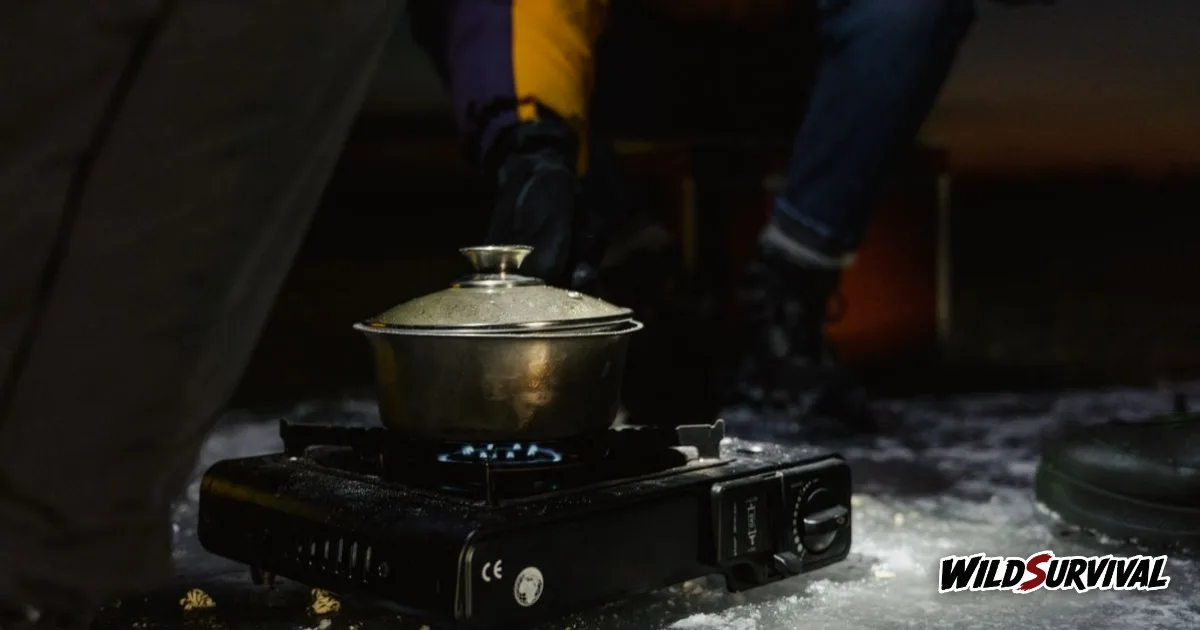
A gas stove in cold weather still works, but it loses power as the temperature drops, because the liquid fuel inside the canister vaporizes less and less. To keep a useful flame, carry a canister rich in propane and isobutane, keep it warm until you cook, and below about -20 °C switch to a remote-canister stove run with the canister inverted, or to a liquid-fuel stove. Here is why, with the numbers the manufacturers publish.
Why a gas stove in cold weather loses pressure
The fuel sits in the canister as a liquid. The burner only gets gas when that liquid vaporizes, and each component of the blend stops doing so below its boiling point. MSR lists those thresholds at sea level in its guide to canister fuels:
| Gas | Boiling point | Behavior in the cold |
|---|---|---|
| Propane | -42 °C (-44 °F) | the best of the three, but too high in pressure to be used alone in a lightweight canister |
| Isobutane | -12 °C (11 °F) | the backbone of backpacking blends |
| Normal butane | -1 °C (30 °F) | stops vaporizing around freezing |
A second effect makes things worse. Vaporization takes energy, drawn from the liquid and from the metal of the canister, which cools down while you cook. Primus describes it on its Winter Gas page: low temperatures cut the pressure in the canister, and the stove burns weaker, or not at all, even with fuel left inside. That is why a flame can fade halfway through melting a pot of snow.
Propane leaves first, since it vaporizes most easily. Meal after meal, the canister runs short of propane, and what remains handles the cold worse and worse. A half-empty canister will disappoint you more than a fresh one when you run a gas stove in cold weather.
Read the fuel blend before you leave
Screw-on canisters all look alike, and the blend printed on the label decides how a gas stove in cold weather will behave. MSR says its IsoPro is 20% propane and 80% isobutane, with a manufacturing tolerance of up to 6% normal butane, usually under 2%. Primus gives a similar mix for its Power Gas, around 20% propane and 80% isobutane.
Primus also sells a propane and butane Summer Gas, designed for temperatures between 15 °C and 40 °C, which belongs at home once nights freeze. Winter Gas uses the same liquid as Power Gas and adds VaporMesh, an absorbent paper lining the inside of the canister. By widening the evaporation surface it keeps the pressure higher, and Primus rates it effective down to -22 °C.
The company published a test run in a cold room at a constant -20 °C, with both canisters left in a freezer for 48 hours first. After 60 minutes of cooking, Winter Gas delivered about 9% more power than a canister without VaporMesh, and around 15% more after 120 minutes. The gap widens as the canister empties, because the paper lining matters more once the liquid level drops, and a final check in that test showed the winter canister could still boil half a liter of water normally.
For a multi-day trip with a gas stove in cold weather, the rule is simple: as little normal butane as possible, as much propane as possible, and a full canister instead of a leftover from summer. If you are still choosing the stove itself, our comparison of BRS, MSR and Jetboil stoves covers the three main burner families.
More articles on WildSurvival
- Paracord 550 Uses: The Mil-Spec Cord in Camp and Its Limits
- Treating Burns Outdoors: Cool, Cover and Call for Help
- Avalanche Risk Snowshoeing: Bulletins, Kit and Safe Routes
What a test between -4 °C and -19 °C shows
The outdoor retailer Scandinavian Outdoor compared an MSR Pocket Rocket 2 and a Primus Lite Plus, burning Primus Winter Gas and Jetboil Jetpower, at +19 °C, -4 °C and -19 °C. Its write-up on gas stoves in winter lists these findings:
- at +19 °C, no difference between summer and winter gas;
- at -4 °C, winter gas was clearly more efficient;
- at -19 °C, summer gas was already much slower;
- winter gas performed almost as well at -19 °C as at -4 °C.
The same article notes that Jetboil lists 25% propane, 70% isobutane and 5% normal butane in its canister. It also points out that when output drops, boiling time grows faster than the power falls, so consumption rises. The authors put the extra burn at 10 to 30% more summer gas in the cold. A struggling gas stove in cold weather costs you fuel as well as time, which matters when snow is your only water.
Keep the canister warm, safely
With a gas stove in cold weather, the basic move is to stop the canister from reaching air temperature before the meal. Scandinavian Outdoor suggests warming it beforehand inside your jacket, or in a container of warm water. A canister that spent the night at the bottom of your sleeping bag starts far better than one left out in the vestibule.
The limit is just as clear. Never overheat a canister and never set it near a campfire, the same guide warns. Primus adds that the container is not designed for excessive pressure, and that an overly strong flame is wasteful and can be dangerous. The benefit of a warm canister also fades within minutes, since it cools again while you cook.
You can watch that cooling happen. Primus explains in its gas guide that evaporation chills the container, sometimes enough for frost to form on the outside. Frost creeping up the canister is a sign that pressure is falling, and a good moment to swap in the canister you kept warm in your jacket, then put the cold one back inside your clothes for the next round. Rotating two canisters this way is a simple habit for long snow-melting sessions with a gas stove in cold weather.
Melting snow eats a lot of gas, so our guide to melting snow to drink safely explains how to cut the heating time.
Remote canister stoves and the inverted canister
On a burner screwed straight onto the canister, you can only draw the vapor. A remote-canister stove, connected by a hose and fitted with a preheat tube, such as the Primus Spider or the Primus Gravity 3 mentioned by Scandinavian Outdoor, lets you turn the canister upside down.
The method has two steps. Light the stove with the canister upright, let it warm up for about 30 seconds, then flip the canister. The stove now draws liquid fuel, and vaporization happens in the preheat tube, away from the cold canister. The blend leaves in the same ratio as inside, so propane is no longer used up first and butane no longer sits at the bottom dragging the pressure down.
A regulated stove helps keep a steady flame, but it cannot create pressure, only smooth out what is there. If you run a gas stove in cold weather every winter, a remote-canister model is the most useful upgrade.
When to switch to a liquid-fuel stove
Primus sets the limit of a gas stove in cold weather itself in its gas guide: below -22 °C, for cooking, boiling water or melting snow, it recommends a multi-fuel stove. Scandinavian Outdoor added a Primus Omnilite Ti to its test. The liquid-fuel stove was the slowest at +19 °C, level with the Pocket Rocket 2 at -4 °C, and the fastest of all at -19 °C.
The pump explains it. Alkylate petrol is pressurized by hand, independent of vapor pressure and therefore of temperature. According to the same test, it still works at -40 °C, with a practical limit somewhere between -40 and -60 °C. In return you have to prime, pump and maintain the stove, and the guide recommends a stove box for a stable, non-flammable base. For a winter camping night at moderate altitude, a good canister kept warm covers most situations.
Quick reference for a gas stove in cold weather
| Around 0 °C | Propane and isobutane canister, no summer blend, kept in your jacket before the meal |
| Down to -20 °C | Fresh winter canister such as Winter Gas, kept in the sleeping bag overnight |
| Lasting cold or daily snow melting | Remote-canister stove with preheat tube and inverted canister |
| Below -22 °C | Multi-fuel stove on liquid fuel, as Primus recommends |
When you pack, be generous with fuel: cold stretches boiling times and melting snow multiplies the liters you need. Carry a spare canister on every winter trip where your gas stove in cold weather is your only source of liquid water.