


To find north without a compass, use the sky. By day, the sun sits due south when it reaches its highest point, so north lies directly behind you as you face it. At night, Polaris, the Pole Star, marks north on its own, and the Plough leads you straight to it. The shadow-stick method is the most dependable daytime option, the analogue watch trick is quicker but far less accurate, and the moss on tree trunks is the clue to treat with the most suspicion.
Using the sun to find north through the day
The sun rises in the east and sets in the west, give or take. The catch is the word “rises”. It comes up exactly due east on only two days a year, at the equinoxes in late March and late September. Through spring and summer it rises between east and north-east and sets between west and north-west, while in autumn and winter it rises between east and south-east and sets between west and south-west. If you aim at a June sunrise to find north, you will swing too far round, so treat sunrise and sunset as a rough first guess.
Midday is far more useful. When the sun reaches its highest point it stands due south, and at that moment the shadow of anything upright is the shortest of the day and points north. To find north this way, you need to know when that moment arrives. Greenwich Mean Time is built on the average moment the sun crosses the meridian at Greenwich, so in winter, around Greenwich, the sun peaks close to 12:00 on the clock. Once the clocks go forward an hour for British Summer Time, from the last Sunday in March to the last Sunday in October, it peaks close to 1pm. Watch the shadow shrink and turn, and trust it over the clock.
All of this depends on seeing the sun. On grey, overcast days, turn to our guide to forest navigation without signal or GPS.
The shadow-stick method, step by step
This technique has an unusual origin. A high school student, Robert S. Owendoff, worked it out in 1960, and a US National Park Service training paper from its Horace M. Albright Training Center explains how it works and records that the US Army formally adopted it on 26 January 1962. All you need is a stick, two stones and about ten minutes.
Push a stick at least 3 feet long into flat, open ground. Put a stone on the tip of its shadow, wait around ten minutes, then put a second stone on the new tip. A line between the two stones runs east to west. Because the shadow moves the opposite way to the sun, the paper notes that the first mark is always west and the second always east, anywhere on Earth.
To find north from that line, stand with your left foot on the first stone and your right foot on the second, and you are facing north. Pick out a distant tree or ridge in that direction and walk towards it, the same way you would hold a bearing, which our guide on how to use a compass with a map walks through in detail.
The National Park Service is upbeat about the accuracy. Close to the equinoxes the error is practically zero, and anywhere in the tropical and temperate zones it is usually within 15 degrees. Only on rare occasions near the solstices does it fall outside what the paper calls “general direction”, an error of no more than 25 degrees.
More articles on WildSurvival
- Dakota Fire Hole: How to Dig an Underground Campfire
- How Much Water to Drink When Hiking, and When to Drink It
- Walking Time in the Hills: Naismith’s Rule and Its Rivals
Why the watch trick can send you the wrong way
Most people half remember the watch method, usually at the moment they need to find north in a hurry. Hold an analogue watch flat and point the hour hand at the sun, and south lies halfway between the hour hand and 12, which puts north on the opposite side. You halve the angle because the hour hand goes round the dial twice for every single turn of the Earth.
That rule assumes 12 on the dial lines up with the moment the sun is due south. During British Summer Time the clock runs an hour ahead, so use the 1 as your reference point in place of the 12 before you halve the angle, or you will find north at an awkward slant.
Even corrected, it stays a rough tool. The same National Park Service paper describes the method as potentially “greatly in error”, especially at lower latitudes, and gives Big Bend National Park in Texas as a place where it can be off by about 70 degrees, enough that for every mile you think you are walking towards your goal, you travel more than two miles off course. It improves towards the poles, particularly in winter, can become useless or even dangerous in the warmer months, and should never be used in the tropics.
The paper’s fix is to set your watch from a shadow-stick reading and check it again with the stick after an hour or so, using the watch for quick glances in between.
Polaris, the Plough and Cassiopeia after dark
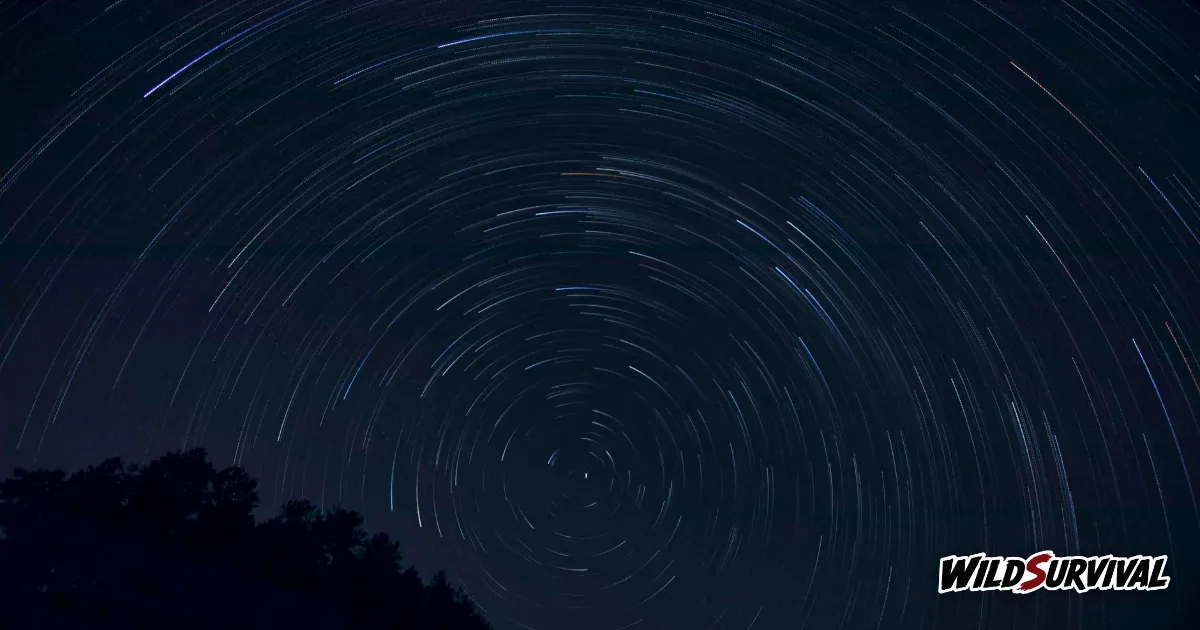
On a clear night, the Pole Star is the surest way to find north. Royal Museums Greenwich explains that you can locate Polaris by following a line drawn through Dubhe and Merak, the two end stars in the bowl of the Plough, which is part of Ursa Major, the Great Bear. As a rule of thumb, carry that line on for about five times the gap between those two stars and you reach a fairly faint, lonely star. That is Polaris.
Face it and you are facing north. The museum notes that Polaris sits almost directly above the North Pole, and that the ancient Greeks already realised it does not mark the pole exactly, though it is close enough for walking. Its angle above the horizon also gives you your latitude.
When trees or hills hide the Plough, look for Cassiopeia, a W shape of five bright stars sitting on the other side of Polaris. The two patterns wheel round the Pole Star through the night and the seasons, so as one climbs the other sinks, and Polaris always lies between them. Spotting either pattern puts you in the right part of the sky to find north.
Reading the moon as a rough backup
The moon follows the same east to west path across the sky as the sun and stars, and its lit side always faces the sun. A full moon rises as the sun sets and stays up all night, a first quarter moon rises around noon and sets around midnight, and a last quarter moon rises around midnight and sets around noon. So a full moon low in the sky early in the evening is somewhere in the east. Because its rising time shifts with each phase, use it to hold a rough direction, then wait for the clouds to part and the Pole Star to find north properly.
Moss on trees makes a poor compass
The old saying is that moss grows on the north side of trees. Helen Keating of the Woodland Trust, the UK woodland conservation charity, explains that moss in the northern hemisphere does tend to grow there, because in the UK it is the side that gets the least sunlight and stays damp and shady. She adds that moss can grow anywhere with enough water, and that wind direction and rainfall shape where it settles.
Deeply grooved bark, dripping water and damp ground near the base of a trunk all suit it too. A mossy trunk tells you a spot is damp and shaded, which makes moss a poor way to find north on its own.
Which sky method to trust when you need to find north
| Method | When it works | How far to trust it |
|---|---|---|
| Shadow stick | Sunny day, about ten minutes | Best by day: almost no error near the equinoxes, usually within 15 degrees |
| Shortest midday shadow | Near 12:00 GMT in winter, 1pm BST in summer | Good, as long as you follow the shadow |
| Sunrise and sunset | Start and end of the day | Rough, shifts with the season |
| Analogue watch | Any sunny moment, in seconds | Approximate, about 70 degrees out in one documented case |
| Polaris | Clear night | Best by night |
| Moss | Any time | Unreliable |
Whenever you can, check one clue against another, Polaris against Cassiopeia at night and the shadow stick against the shortest shadow by day. Practise on a clear evening near home, so you can find north in a few minutes on the day it really counts.