

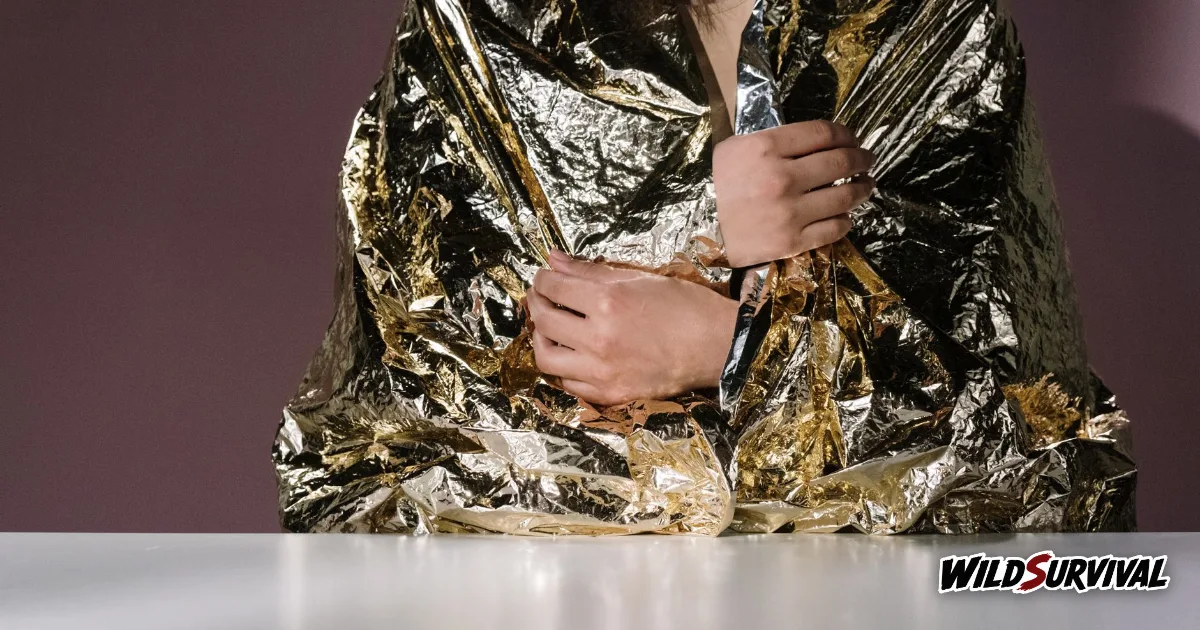
A survival blanket works when you wrap the casualty completely, head included and face left clear, after getting them off the ground and out of wet clothing. French fire-service doctrine puts the silver side against the body in the cold and the gold side against the body to shield someone from the sun. A medical review published in 2022 says the side matters very little against the cold, and that how tightly and how completely you wrap the casualty is what actually keeps heat in.
What a survival blanket is made of
The survival blanket is a very thin plastic sheet coated with aluminium. NASA’s Spinoff feature on the material describes it as a strong, vacuum-metallised plastic film with a highly efficient, infrared-reflective coating of aluminium, developed for the American space programme before it found its way into first aid kits.
A NASA Spinoff feature from 1976 traces that history: the aluminised Mylar film was developed for the Echo satellites and for space suit insulation, before an American company, MPI Outdoor Safety Products, turned it into a survival blanket. The same feature already claimed the blanket could be used equally well to keep heat away or to keep available heat in, a dual role that survival blanket makers still advertise today.
The gold side has no special property. Dejan Slabe and Rok Fink, researchers at the University of Ljubljana, explain in their 2014 study that the film is PET coated with aluminium on the silver side, and that the gold colour comes from a yellow dye that plays no particular part in how the sheet handles heat.
The film blocks wind, keeps rain off and traps some of the air warmed by the body. It produces no heat of its own, so a survival blanket laid over someone who is already very cold slows further heat loss and does nothing to warm them back up.
Which way round should a survival blanket go?
The French fire-service technical sheet SUAP-FM-29, updated in December 2025, gives the rule repeated across most first aid courses: the blanket limits heat loss when the silver side faces the casualty, and protects them from the sun when the gold side faces them.
The medical literature is far less certain about the cold. The review by Sylweriusz Kosiński and colleagues in Wilderness & Environmental Medicine (2022) concludes that when a reflective foil is used to protect against hypothermia in a wilderness emergency, it does not matter whether the gold or silver side faces outward. The authors point out that the heat radiated from a well-clothed body is minimal, so the reflective properties of the foil count for relatively little.
The side matters more in the heat. Slabe and Fink took their measurements during a heatwave in June 2013 and found the air under the blanket 6 °C warmer at peak heat when the gold side faced out. With a hot water bottle at 37 °C standing in for a body, they recorded 44 °C under the blanket with gold facing out against 31.7 °C with silver facing out.
| Situation | Which side | What matters most |
|---|---|---|
| Cold, wind, rain | Silver to the body (French doctrine), little measurable effect according to Kosiński | Wrap tightly, insulate from the ground, add layers |
| Sun, heat illness | Gold to the body, silver facing out | Get the person into shade |
| Snow and glaciers | No difference for warmth | Most visible side facing out for rescuers |
More articles on WildSurvival
- Layering System for Hiking: How to Dress for the Hills
- Trekking Poles: How to Set the Length and Use Them Well
- Emergency Water Supply: How Much to Store at Home
Wrapping someone in a survival blanket
Since the side counts for so little in the cold, the technique decides how well a survival blanket performs. Kosiński’s review notes that protection from insulating materials depends mostly on their ability to trap air, and improves with every extra layer. The French fire-service sheet adds three instructions: wrap the casualty completely, avoid pressing on injuries, and pass the blanket underneath them where you can.
St John Ambulance gives a clear order for a hypothermic casualty outdoors. Lay them on a thick layer of dry insulating material such as pine branches, heather or bracken, wrap them in a foil survival blanket if you have one, and make sure their head is covered. Cold, wet ground pulls heat out of the body fast, which is why that bottom layer comes first.
- Get the casualty out of the wind and rain, behind a boulder or under a tarp.
- Remove wet clothing, as the NHS advises, and swap in dry layers if you carry any.
- Insulate from the ground with a sleeping mat, an emptied rucksack or dry vegetation.
- Wrap snugly, head included, leaving the face uncovered.
- Add a jacket, sleeping bag or second blanket over the top.
Where a survival blanket falls short
Kosiński and his co-authors warn that heat reflection suffers when moisture condenses or freezes on the inner surface, and when the foil sits tight against the outermost layer of clothing. In their view a single foil may help in light wind and moderate temperatures, while in cold, windy weather it probably serves best as a waterproof outer cover over proper insulation.
Carry one in your first aid kit as a last line of defence, with a genuinely warm layer alongside it, a down jacket or a sleeping bag. The NHS also says not to rewarm someone with hypothermia using a hot bath, a hot water bottle or a heat lamp, and not to rub their arms and legs. Our guide to recognising and treating hypothermia covers the warning signs and what to do next.
One more practical point: practise once at home. Unfolding a survival blanket in wind with cold hands is fiddly, and the foil tends to flap away. Knowing in advance how to tuck it under the casualty and fold it around the feet saves precious minutes on the hill.
Lightning, defibrillators and being seen
The French fire-service sheet points out that the blanket is a metallised film that can conduct electricity, the source of the common advice to avoid using one during a thunderstorm. An experimental study published in Coatings in 2025 by Mathias Isser’s team exposed blankets on mannequins to strikes of up to 2.5 million volts: the foil diverted surface currents and kept current away from the mannequins. That is a single laboratory study, and the cautious advice stands until other research backs it up.
We found no medical study looking at survival blankets during defibrillation. Common sense applies: clear the chest so the pads can go on, as the device instructs.
One use people forget is visibility. A team of Innsbruck doctors noted in a 2022 commentary that the gold side facing up makes a casualty easier to spot on snow and glaciers. Our article on how to signal your position in an emergency picks up from there.
Choosing and storing a survival blanket
The French fire-service sheet lists a 1.80 m by 2.20 m format, and the blanket tested by Slabe and Fink measured 160 by 210 cm. Pick a size that covers a lying adult from head to toe, with enough spare to tuck underneath. The film tears easily once unfolded, so keep it sealed in its original packet until the day you need it, and replace it if it has been opened or crumpled.
A survival blanket weighs next to nothing and folds down to the size of a handkerchief. It earns a place in every pack, from the 72-hour survival kit to a day-walk rucksack, as long as you know what it really does: cut the wind, keep water out and hold warm air around the body.