


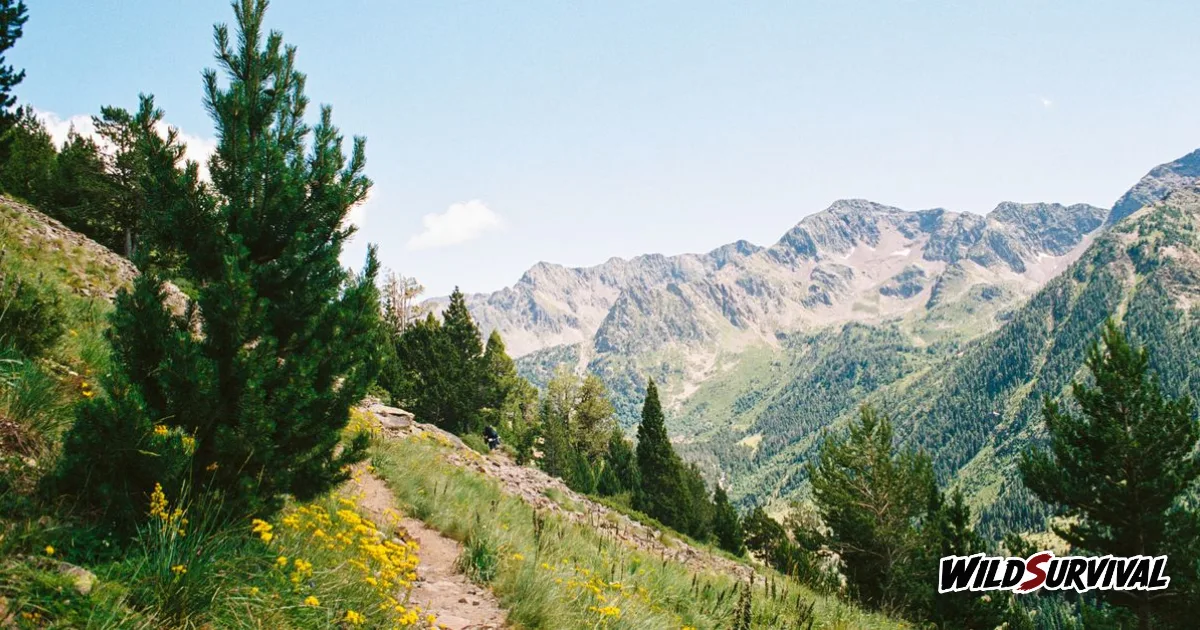
The GR10 Pyrenees trail crosses the French side of the range from Hendaye on the Atlantic to Banyuls-sur-Mer on the Mediterranean. Depending on the source, it runs from 922 km to about 1,100 km, adds up to roughly 55,000 m of ascent, and takes one month to six weeks for a full thru-hike. The walking season runs from mid-June to late September, depending on snow, with nights in staffed refuges, gîtes, unstaffed huts and wild camps, and tight camping rules in the core of the Pyrenees National Park. Here is what you need to plan the route, with every figure sourced.
Contents
How long the GR10 Pyrenees really is
A route born in the Aspe and Ossau valleys
The mid-June to late September window
Four guidebooks for four massifs
Refuges, gîtes and huts along the way
Wild camping in the Pyrenees National Park
How long the GR10 Pyrenees really is
Start by accepting that the length has no single answer. The French Hiking Federation’s page on the GR10 gives about 1,100 km from Hendaye to Banyuls, against nearly 450 km as the crow flies between the two seas. The volunteer-run site gr10.org, written by hikers who have walked it, puts the GR10 Pyrenees distance at 922 km. The trip report on i-trekkings says roughly 900 km.
Elevation works the same way. The volunteer site quotes 55,000 m of ascent in one panel and 58,000 m in another without explaining the gap, and i-trekkings settles on close to 55,000 m. Variants, detours down to accommodation and different measuring methods explain the spread. Plan stage by stage from the GPS track and the guidebook, and treat the totals as a rough order of magnitude.
The federation also notes that the GR10 Pyrenees route rarely drops below 1,000 m and climbs over high passes such as the Hourquette d’Arre at 2,465 m. The Fourcat refuge, in the Ariège Pyrenees, sits at 2,445 m.
A route born in the Aspe and Ossau valleys
According to the federation, the first sketches of the trail date from 1963 in the Aspe and Ossau valleys. The first stretches between Hendaye and La Pierre Saint-Martin appeared in 1968, and the whole route was overhauled in the mid-1990s with local authorities. Along the way the GR10 Pyrenees trail crosses the Basque Country, Béarn and part of Bigorre, enters the Pyrenees National Park at the Pic d’Anie, then reaches the Pyrénées-Orientales and the Canigou massif.
More articles on WildSurvival
- Paracord 550 Uses: The Mil-Spec Cord in Camp and Its Limits
- Treating Burns Outdoors: Cool, Cover and Call for Help
- Avalanche Risk Snowshoeing: Bulletins, Kit and Safe Routes
How many days to allow for the GR10 Pyrenees
The federation talks about “a good month and a half, or a month for the sporty ones.” The volunteer site gives an average of about 55 days and between 355 and 368 hours of walking depending on the panel. The spread mostly tells you that your own pace decides everything: a hiker stringing together long days will finish weeks ahead of someone who builds in rest days.
The i-trekkings report shows what the eastern half looks like: from Cauterets to Banyuls, 608 km split into 30 stages of 13.9 to 26.5 km. Its author describes a demanding trail for fit, durable hikers who can handle long days with big climbs back to back, with some stages stretched out because there is nowhere to sleep in between. To estimate your own days, our guide to walking time and Naismith’s rule fits the Pyrenean profile well.
Plenty of hikers split the GR10 Pyrenees traverse over several summers, one massif at a time. The guidebook split described below lends itself to that. A sensible way in is to walk one section first, such as the western stretch out of Hendaye, and judge your daily distance there before committing to the full GR10 Pyrenees traverse. That trial run also shows you how much weight you can carry comfortably over several consecutive days of big climbs.
The mid-June to late September window
According to i-trekkings, the trail is only passable from mid-June to late September, depending on snow. The volunteer site makes the same point: you need to know the snow conditions on the high passes before setting off, and it runs a dedicated page on snow watch along the route. A late snowfield on an exposed col changes the difficulty of a stage completely.
The season also shapes where you can sleep. The same site points out that not every hut and gîte is open all the time, and that opening periods depend on the month and the sector. If you start early or finish late in the season, check each night one by one. The federation sums up the spirit of it in a 2023 article: summer hikes are prepared in winter.
Four guidebooks for four massifs
The French federation publishes the GR10 Pyrenees route in four volumes of its “La Traversée des Pyrénées” series, with an extra guide to the Gavarnie and Vignemale massifs. The volunteer site uses the same four-way split to sort its accommodation lists.
| FFRandonnée guidebook | Reference |
|---|---|
| La Traversée des Pyrénées, western Pyrenees | 1086 |
| La Traversée des Pyrénées, central Pyrenees | 1091 |
| La Traversée des Pyrénées, Ariège Pyrenees | 1090 |
| La Traversée des Pyrénées, eastern Pyrenees | 1092 |
| Au cœur des massifs de Gavarnie et du Vignemale | T651 |
The guidebooks are in French and remain the reference for stages, variants and access points. Editions age, so confirm closed accommodation or rerouted sections with tourist offices and the news pages of hiking associations before you go.
Refuges, gîtes and huts along the GR10 Pyrenees
The volunteer site lists gîtes, refuges, inns, hotels and B&Bs by region, plus a separate list of wild camping spots and campsites. For the eastern half, the i-trekkings report suggests somewhere to sleep at every stage, whether a staffed refuge, a hut, a gîte d’étape or a hotel, and says its list is partial. Examples include the Oulettes de Gaube refuge, the Ruhle refuge, the Cabane d’Aula with its 12 bunks, stove and cookware, and the Cortalets refuge below the Canigou.
Unstaffed huts give you a free roof for the night, according to the same report. They come with basic etiquette around firewood, cleaning up and making room for others, which our guide to the unstaffed mountain hut covers in detail.
Should you book? The volunteer site gives the question a whole article, which says a lot. In practice, booking staffed refuges in summer secures your plan, while carrying a tent leaves you room to adjust when a stage runs long.
Wild camping in the Pyrenees National Park
Wild camping is possible along the whole trail, but it is regulated in the Pyrenees National Park and in nature reserves. In the core of the park, the order of 29 August 2013 on camping and bivouacking bans camping and allows an overnight bivouac only under three conditions:
- in a tent too low to stand up in, or in a natural shelter;
- between 7 pm and 9 am;
- more than an hour’s walk from roads open to vehicles, or on an approved site marked on the ground.
I-trekkings flags local rules in some reserves, such as the Néouvielle, where bivouacking is only allowed at the Orédon and Aubert lakes, from 7 pm to 9 am. Outside the park, the general French rules apply, which we summarise in our article on wild camping in France. Pitch late, pack early and leave nothing behind.
Resupply and water
The volunteer site warns that resupplying on the GR10 Pyrenees route “is no easy thing” for anyone used to towns. On the eastern half, the i-trekkings report names places to shop such as Cauterets, Luz-Saint-Sauveur, Bagnères-de-Luchon, Mérens-les-Vals, Arles-sur-Tech and Banyuls-sur-Mer. Its author adds that some village shops carry very little, and that several refuges can serve a meal or sell snacks and drinks.
The same site points to a handy oddity: the stocked hut at Clarans, in the Ariège Pyrenees, where you pay for what you take. Water is one of the things the association rates most important to plan for. Mark springs on the map, ask at refuges about the state of water sources, and carry a way to treat what you drink. On stretches without shops, keep a buffer of food and phone the next grocery before relying on it, especially early or late in the season. Plan each food carry from one confirmed shop to the next, and write down its opening days.
GR10, GR11 or HRP
Three long routes cross the range, according to the volunteer site: the GR10 on the French side, the GR11 on the Spanish side, and the Haute Route Pyrénéenne, or HRP, which weaves between the two close to the ridges. They meet in many junction zones; right after Hendaye, for instance, the HRP leaves the GR10 and drops into Spain towards the Col de Lizuniaga.
I-trekkings describes the HRP as more demanding, meant for experienced hikers both physically and in navigation. The GR10 Pyrenees trail stays waymarked and dotted with places to sleep, which makes it the natural way in. If you have already done the GR20 in Corsica, expect the same physical commitment stretched over a far longer trip.
Getting there and moving your bags
Both ends of the trail are reachable by train, Hendaye on the Atlantic side and Banyuls-sur-Mer on the Mediterranean. Joining a section partway along often means a train followed by a bus: the i-trekkings report describes reaching Cauterets, the start of its eastern traverse, that way. Build those connections into your plan early, since mountain lines run few services outside summer.
Baggage is the other early decision. According to the same report, no company carries bags along the whole trail, nor even on the Cauterets to Banyuls section. Its author suggests asking taxis and tourist offices, or booking a self-guided trek with an agency such as La Balaguère or Randonades, which can sometimes arrange transfers. Going self-supported means your pack carries a tent, a sleeping system, a stove and several days of food on the remote stretches.
Many hikers add a nearby summit as an out-and-back. I-trekkings gives 3,298 m for the Vignemale, the highest point in the French Pyrenees, and 2,784 m for the Canigou; the federation lists the Canigou at 2,785 m and notes that its summit sits off the GR10 Pyrenees line. These detours add hours to a stage and are best decided on the day’s forecast.
Key numbers for the GR10 Pyrenees at a glance
| Start and finish | Hendaye (Atlantic) and Banyuls-sur-Mer (Mediterranean) |
| Distance | 922 km (gr10.org) to about 1,100 km (FFRandonnée) |
| Ascent | 55,000 to 58,000 m according to gr10.org |
| Duration | One month to six weeks (FFRandonnée), about 55 days on average (gr10.org) |
| Season | Mid-June to late September, depending on snow |
| Camping in the park core | 7 pm to 9 am, over an hour’s walk from a road |
Pick your format first, one continuous push or sections over several summers, then build your stages from the guidebook for that massif and check that every night’s accommodation is open. The GR10 Pyrenees rewards the planning you do at home.