

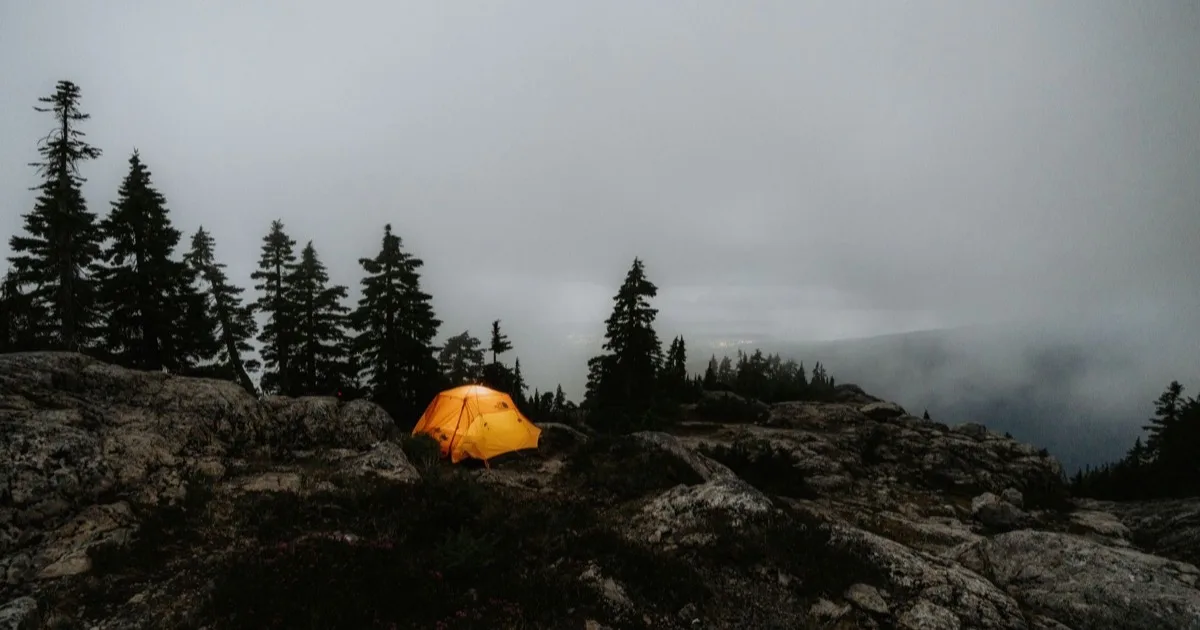
Wild camping in France starts from a permissive rule: the French planning code allows camping away from roads, as long as whoever has the use of the land agrees. That freedom has four national exceptions (the seashore and listed sites, protected “classified” sites, the surroundings of historic monuments, and 200 m around drinking-water intakes), plus local bans set by town halls and stricter rules in each national park. Lighting a fire in or within 200 m of woodland is banned for anyone other than the landowner.
What French law says about wild camping in France
The starting point is article R111-32 of the Code de l’urbanisme, the French planning code. In our translation, it says that camping may be freely practised away from roads and public highways, under the conditions of that section of the code, with the agreement of whoever has the use of the land and subject to any objection from the owner. On private land, that means you need permission from the farmer or the owner.
French law has no national definition of a bivouac. The planning code only talks about “camping”, and the word bivouac appears in the environment code as something national parks may regulate, without a general definition. The only written definition we found is local: the June 2026 order issued by Écrins National Park describes a bivouac as a light, temporary setup meant for a single night outdoors.
In practice, the line between a bivouac and camping matters most in protected areas, where the rules allow one and ban the other. Everywhere else, your tent falls under the general camping rules.
The four places where camping alone is banned
Article R111-33 of the French planning code, in the version in force since 2017, bans “camping pratiqué isolément”, meaning camping on your own outside a campsite, in four kinds of place unless an exemption applies:
- on the seashore and in sites listed under the environment code;
- in classified sites or sites in the process of being classified;
- within “remarkable heritage sites” and in the surroundings of historic monuments;
- within 200 metres of water sources tapped for drinking water.
The current text refers to the “surroundings” of historic monuments without setting a distance itself. Before you pitch near a monument, a well-known beauty spot or the coast, check the status of the place on the signs at the entrance or with the town hall.
Article R111-34 adds a local layer. A town’s planning rules or a mayor’s order can ban camping where it threatens public health, safety or peace, the landscape, the natural environment, or farming and forestry. Those bans only apply once they are posted at the town hall and signposted at the usual access points, so a sign at the edge of a site is the one to respect.
More articles on WildSurvival
- How to Pitch a Tarp: 5 Setups for Wind and Rain
- Foraging Wild Mushrooms, the Basic Safety Rules
- Field-Repairing Your Hiking Gear, the Kit Worth Carrying
Bivouac rules in the national parks
The core zones of France’s national parks follow stricter rules, set by each park’s own order. Evening and morning hours and a minimum distance from roads come up again and again, with differences worth checking before every trip. Each park can revise its order, as the Écrins did in 2026 when it replaced its 2014 rules, so treat the details below as a starting point and read the current text on the park’s own website.
In the Écrins, Écrins National Park’s order no. 148/2026 on bivouacking lets you set up after 7 pm and requires you to pack away before 9 am, unless the weather makes that unsafe. The tent must be small, too low to stand up in, and you spend only one night in the same spot. You must be more than an hour’s walk from the edge of the core zone, from car parks and from roads, except at Pré de la Chaumette and near the Olan hut. Bivouacking is banned within 500 m of the Lauvitel and Muzelle lakes outside marked areas, only gas stoves are allowed, and the park may bring in quotas and booking.
In the Vanoise, the park allows bivouacs in summer, only near certain mountain huts, from 7 pm to 8 am, with booking through the hut wardens and a light tent. In the Mercantour, a 2018 order sets bivouacs at more than an hour’s walk from road access, from 7 pm to 9 am, one night per spot, and limits them to two areas near the huts in the Merveilles and Fontanalbe rock-engraving zone. In the Pyrenees, a 2013 order bans camping in the park’s core and allows bivouacs from 7 pm to 9 am, more than an hour’s walk from roads open to traffic or on marked areas.
Nature reserves have no single rule: the environment code lets each reserve’s founding decree regulate or ban people moving or stopping within it. Check with the reserve’s managers before planning a night there.
State forests, run by the French forestry office ONF, can carry their own bans too. The FAQ of the ONF’s Île-de-France West agency states that bivouacking is prohibited in all state forests in the Île-de-France region around Paris and that camping there is strictly forbidden, with only the Rambouillet forest offering dedicated facilities. That applies to this region only: we found no national ONF page on the subject, so ask the local agency about any other state forest.
Campfires and the French forestry code
Fires follow a national rule. Article L131-1 of the French forestry code bans anyone other than the owner or those acting for them from carrying or lighting fire on wooded land and within 200 metres of woods and forests. Under article R163-2 of the same code, breaking that rule carries a fourth-class fine.
National parks often go further. In the Écrins, the 2026 order bans all fires and only allows gas stoves. Prefectures, the state’s local authorities in each département, also issue seasonal orders on the use of fire, and these vary from one département to the next, so check the one for the area you are walking in before you set off.
The Écrins and Vanoise orders allow stoves where they ban fires. Keep campfires for land where the owner has given you clear permission.
Fines set out in French law
Amounts depend on the class of offence. The French penal code caps fines at 450 euros for a third-class offence, 750 euros for a fourth-class offence and 1,500 euros for a fifth-class offence. Breaking a national park’s core-zone rules on bivouacking and camping is a third-class offence under article R331-64 of the environment code, and a fire in woodland is a fourth-class offence.
Those figures are legal maximums. The amount you would actually be asked to pay depends on the procedure, and we found no official source setting a standard fine for an unauthorised bivouac. Sticking to the hours, the distance from roads and the fire ban remains the safest approach to wild camping in France.
Planning wild camping in France, step by step
Before you go, work out what kind of land your route crosses: private land, forest, coast, a classified site, a national park core zone or a nature reserve. Each one has its own rule. On private land, ask for permission. In a park’s core zone, read the park’s bivouac order and book if required. Once on the ground, our guide to choosing your campsite location adds the practical checks on terrain.
On the night, pitch late and pack up early, keep well away from water intakes and streams, and cook on a stove. If you sleep under a tarp rather than a tent, our guide on how to pitch a tarp helps you choose a light, low-profile setup.
Wild camping in France comes down to a few habits: check the status of the land, respect the evening and morning hours, stay well away from roads in the mountains, and leave the campfire at home.