

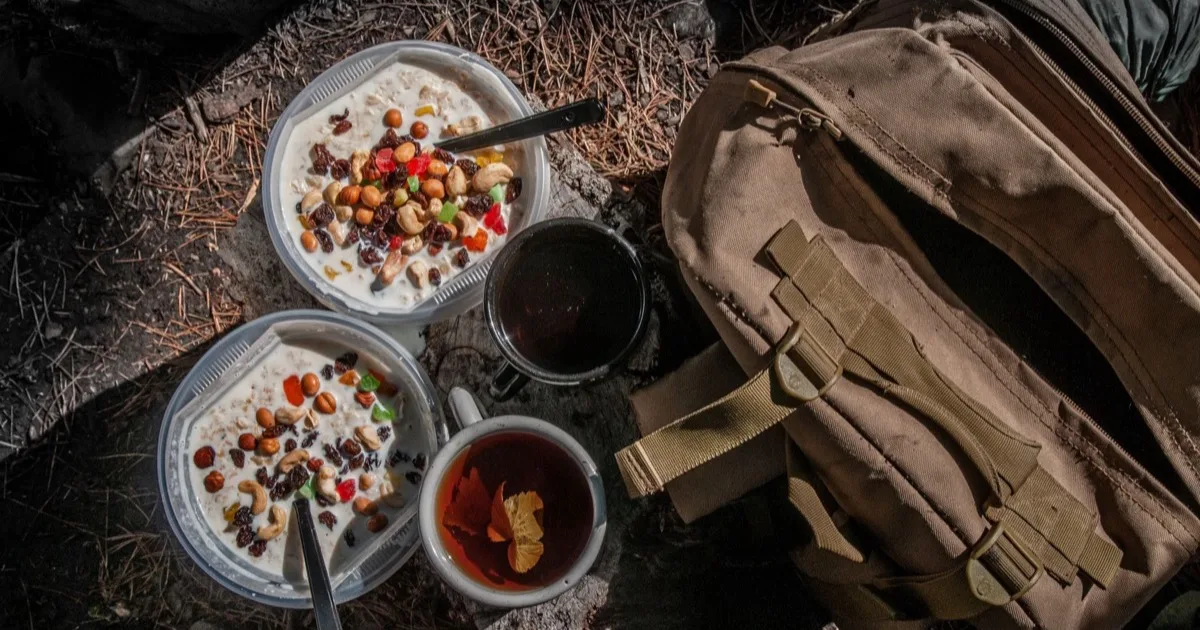
Planning food for a multi-day hike starts with how much energy you burn: the outdoor school NOLS puts daily needs anywhere from 2,000 to 5,000 kcal depending on weather and effort, which works out to roughly 450 g to 1.1 kg of food per person per day. You cover that with energy-dense food eaten little and often while you walk. Fat is what keeps your pack light, because it carries more than twice the energy of carbohydrate or protein for the same weight.
How many calories a multi-day hike burns
The NOLS guide to planning a camping menu sorts daily needs by conditions. A short trip in mild weather calls for 2,000 to 3,000 kcal. Cool weather with moderate effort pushes that to 3,000 to 3,500 kcal, cold weather with sustained effort to 3,500 to 4,500 kcal, and full winter conditions to 4,000 to 5,000 kcal.
The French mountaineering federation’s medical commission (FFME) gives a single benchmark in its fact sheet on eating while hiking: a 65 to 70 kg walker carrying a 5 to 8 kg pack, in summer and in the mid-mountains, burns 500 kcal an hour, or 4,000 kcal a day. The same sheet notes that a sedentary person uses 2,000 kcal, so a hiking day roughly doubles your usual intake.
Those ranges are wide for good reason, since body weight, pack weight, climbing and cold all move the number. The FFME also points out that on a trip of several days, eating too little shows up as the body drawing on its fat stores and losing weight.
How much food to carry for each day on the trail
Once you know your calorie target, weight comes down to calorie density, meaning how many calories each gram of food holds. Andrew Skurka, a long-distance hiker and guide, notes that an ounce of fat holds 240 calories against 100 for an ounce of carbohydrate or protein. In metric terms that is about 8.5 kcal per gram for fat and about 3.5 for the other two.
In his list of recommended backpacking snacks and lunches, Skurka says most hikers aim for more than 100 calories per ounce for most of their trail food. A full day of 2,250 to 2,750 calories then weighs 18 to 22 ounces, roughly 510 to 625 g, at an average of 125 calories per ounce.
NOLS works straight in weight, and its figures line up with that range at the light end.
| Conditions (NOLS) | Calories per day | Food per day |
|---|---|---|
| Short trip, mild weather | 2,000 to 3,000 kcal | 1 to 1.5 lb (450 to 680 g) |
| Cool weather, moderate effort | 3,000 to 3,500 kcal | 1.75 to 2 lb (790 to 910 g) |
| Cold weather, sustained effort | 3,500 to 4,500 kcal | 2 to 2.5 lb (910 g to 1.1 kg) |
| Extreme cold, winter | 4,000 to 5,000 kcal | 2 to 2.5 lb (910 g to 1.1 kg) |
For a five-day trip in mild weather with no resupply, that table puts your starting food load at 2.3 to 3.4 kg. That is the figure that makes dense food worth the effort of planning.
More articles on WildSurvival
- How to Pitch a Tarp: 5 Setups for Wind and Rain
- Foraging Wild Mushrooms, the Basic Safety Rules
- Field-Repairing Your Hiking Gear, the Kit Worth Carrying
What to eat on a multi-day hike, meal by meal
The FFME suggests a standard split of 50 % carbohydrate, 35 % fat and 15 % protein, and describes fat as the fuel for long efforts and for fighting the cold. Breakfast can lean on oats with powdered milk and dried fruit, which pack small and only need hot water.
On the move, the FFME lists dried fruit, fruit jellies, sweetened condensed milk, biscuits, chestnut spread and energy bars. It advises against fresh fruit, which is heavy and awkward to carry, and recommends cheese, butter and condensed milk in a tube for very cold weather. Skurka takes the same approach with four to seven snacks a day, a habit he calls a “caloric drip”.
Dinner is where you rebuild. Couscous, instant mash, instant noodles or freeze-dried meals all come together with a little hot water, and a splash of olive oil stirred in raises the energy of the meal a lot for very little extra weight. If you cook on a stove, our comparison of camping stoves from BRS, MSR and Jetboil covers which system suits this kind of cooking.
Water and salt over several days
You cannot carry five days of water, so you collect it on the way. The FFME recommends drinking regularly in small amounts, every fifteen minutes, and drinking more in hot weather or at altitude. It also warns that shop-bought energy drinks are usually too concentrated and should be diluted.
According to the same sheet, an evening soup does two jobs at once: it rehydrates you and it puts back the minerals lost during the day. A soup sachet or a stock cube weighs a few grams and earns its place in every day’s bag.
Be wary of streams that look perfectly clear. The FFME notes that water can carry bacteria if it has passed through grazing land, livestock areas or the surroundings of a mountain hut further up. Our guide to purifying water without a filter runs through the methods worth packing.
Packing your rations at home
The real work happens on the kitchen table, one day at a time. Weigh each day’s food, strip out the extra packaging and bag up breakfast, snacks and dinner for each day separately. A light or heavy day shows up straight away, and you will not eat on day one what was meant for day four.
Favour food that keeps without a fridge and copes with the warmth of a pack: dried fruit, nuts, hard cheese, dry-cured sausage, oats and powdered milk. Try every item on a day walk first, before it joins a multi-day hike.
Label each day’s bag with its number and a rough calorie total from the packets. On the trail, that label tells you at a glance whether you are eating ahead of plan, so you can correct course while there are still several days of food left to rebalance.
Cold weather changes the balance. The FFME’s advice to add cheese, butter and condensed milk when it is very cold follows the same logic as Skurka’s numbers: fat packs the most energy per gram, and that energy is exactly what the body spends on staying warm through a long night at camp.
Finally, pack one extra day of food in case weather or an injury keeps you out longer than planned. Keep it at the bottom of the pack, separate from the daily bags, so it stays untouched unless you genuinely need it.
A sample day of trail food
Here is a day to adapt, built from the foods the FFME lists and Skurka’s little-and-often approach. Breakfast is oats with powdered milk and dried fruit. On the trail, a snack roughly every hour: a bar, a handful of nuts, a fruit jelly, a chunk of cheese. Lunch is flatbread or wraps with hard cheese and dry-cured sausage. In the evening, a soup first, then couscous or a freeze-dried meal with olive oil, and something sweet to finish.
Put that day on your kitchen scales, compare the total with the NOLS row that matches your conditions, then adjust. Food for a multi-day hike takes a little arithmetic before you leave, and it pays off from day two, when your energy lasts all the way to camp.