


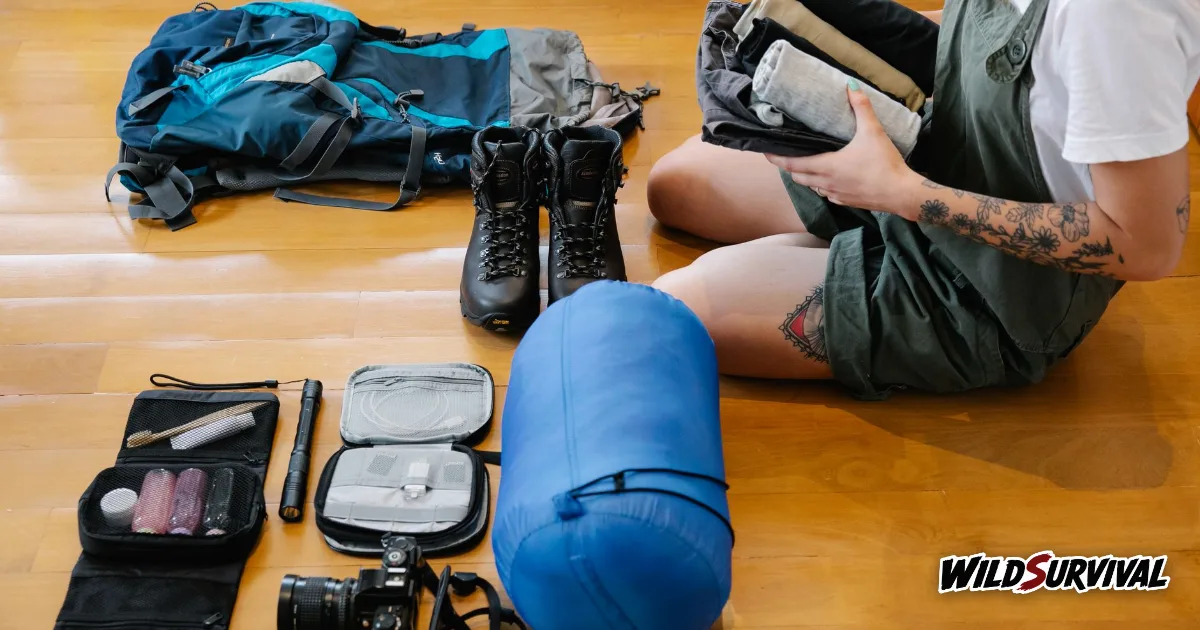
Ultralight backpacking means bringing your base weight, the weight of everything in your pack apart from food, water and fuel, under 10 pounds, which is about 4.5 kg. Lightweight sits between 10 and 20 pounds, and anything heavier counts as conventional. The way in is to weigh every item, write it all down, and start with the big three: pack, shelter and sleep system, while your warm layer and your first aid kit stay in the pack whatever the scales say.
Base weight, the number ultralight backpacking runs on
Base weight is the figure every lightweight hiker ends up comparing. The base weight guide by Darren Edwards at Trail Hiking Australia defines it as the total weight of all the gear in your pack, excluding food, water and fuel. Those three are the consumables. They shrink as the days go by, while the rest of the kit weighs the same on the last mile as on the first, and that stable number is what makes comparisons between hikers and between trips possible.
Edwards lists what goes into the total: shelter and sleep system (tent, stakes, sleeping bag and mat), the pack itself with its liners and dry bags, any clothing carried in the pack such as insulating layers, shells and spare socks, the cooking hardware without its fuel, and the navigation and safety kit, from map and compass to headlamp and first aid.
The only thing he leaves out is what you are wearing at the trailhead. Boots on your feet, hiking trousers and the shirt on your back sit outside the calculation, whereas the fleece rolled up at the bottom of the pack counts. That rule has a practical side worth keeping in mind: a puffy jacket you only pull on at camp still adds to your base weight, and it still earns its place.
To know what your shoulders will actually carry on the first morning, add the water, food and fuel you plan to start with. That figure can swing a lot between routes, depending on the gaps between water sources and the number of days between resupplies, and the water a route demands always goes in the pack, whatever your ultralight backpacking goal. Base weight stays the number to track, because it holds steady whether the trip lasts two days or ten.
Ultralight, lightweight or conventional: where the lines sit
The categories are written in pounds, and the metric versions you see online depend on how they were rounded. The FarOut guide to calculating base weight splits hikers into three groups: conventional above 20 pounds, lightweight between 10 and 20 pounds, and ultralight below 10 pounds.
| Category | Base weight | Metric equivalent |
|---|---|---|
| Conventional | more than 20 lb | more than 9.1 kg |
| Lightweight | 10 to 20 lb | 4.5 to 9.1 kg |
| Ultralight | under 10 lb | under 4.5 kg |
The edges are a little soft. Olivia Magee, writing for the ultralight gear maker Zpacks in a blog post on keeping base weight low, describes ultralight as a base weight of 10 pounds or less, so a pack sitting exactly on the line counts in one definition and misses out in the other. That small gap says a lot about how these categories work in practice: they help you place yourself and compare lists with other hikers, and the label matters far less than the route you can walk safely with the kit.
For a realistic first target, Edwards gives two working ranges for base weight: 7 to 9 kilograms for lighter three-season trips, and 9 to 13 kilograms for trips that call for more self-sufficiency. If your first weigh-in lands inside those numbers, you are starting from a sensible place, and ultralight backpacking becomes a direction to work towards one trip at a time.
More articles on WildSurvival
- Dakota Fire Hole: How to Dig an Underground Campfire
- How Much Water to Drink When Hiking, and When to Drink It
- Walking Time in the Hills: Naismith’s Rule and Its Rivals
Weigh and list every item before buying anything
The method is simple and slightly tedious. Edwards recommends weighing each item individually on a kitchen scale and recording the numbers in a simple list or spreadsheet. Weighing the full pack on a luggage scale tells you where you stand, but only the item-by-item list tells you where the weight hides.
Weigh everything, including the small things that never seem worth the trouble: stuff sacks, the pouch your first aid kit lives in, the compression sack for the sleeping bag, the headlamp with its batteries, your knife and lighter. Each line gets its exact weight in grams or ounces, and the list turns into the honest inventory every ultralight backpacking plan starts from.
Once the list is complete, group it into blocks: shelter, sleep system, pack, kitchen, clothing, hygiene, navigation and safety. Add up each block. Within a few minutes the subtotals show where the weight sits, and the next step becomes obvious.
Keep the clothes you hike in on a separate line at the bottom of the list. They stay out of base weight, as Edwards explains, but writing them down gives you the full picture of what your body carries on the trail, and it stops a heavy jacket from quietly moving from the pack to your shoulders just to flatter the numbers in your ultralight backpacking spreadsheet.
Add one more column for notes after every trip, marking anything that came home without being used. Olivia Magee’s first piece of advice at Zpacks is to remove the items you did not use on your last hike, and that column gives you the evidence to do it with confidence, which is how ultralight backpacking grows out of real trips.
Pack, shelter and sleep system: the big three come first
On the same Zpacks blog post, Magee tells readers to focus on the big three, the backpack, the sleeping bag and the shelter, because those items weigh the most. Edwards names the same three, shelter, sleep system and pack, as the place where the biggest gains are found. Look at your block subtotals: if those three sit at the top, that is where your ultralight backpacking work begins.
For shelter, the usual routes to a lighter setup are a one-person tent, a tent that pitches with trekking poles, or a tarp. Each option asks you to know how it copes with wind and rain before you take it far from the car. Our roundup of the best lightweight backpacking tents puts several models side by side if you are ready to replace the tent you have.
The sleep system, meaning the sleeping bag or quilt together with the sleeping pad, deserves the most care of the three. Cutting weight here changes your night directly, and your safety with it if the temperature drops. On this item the comfort rating comes first, ahead of the weight printed on the label. Before swapping a bag for something lighter, check that rating against the coldest night you expect on the route, and remember that the pad underneath you is what insulates you from the cold ground. Ultralight backpacking only pays off if you sleep well enough to walk the next day.
Leave the pack until last. Once the shelter and sleep system are smaller and lighter, the volume you need shrinks, and a smaller, lighter pack becomes realistic. Our guide to hiking backpack capacity helps you size the new one once everything else is settled.
What comes out of the pack first, for free
The cheapest gram is the one you stop carrying. Go back to the column of unused items and take out everything that has stayed in the pack untouched for your last two or three trips, safety kit excepted. In ultralight backpacking, this is the one step that costs nothing at all.
Duplicates go next: two headlamps, two knives, two mugs, three spare shirts. Keep one of each, and look for items that can do two jobs, which Magee also recommends. A pot that doubles as a bowl, or trekking poles that hold up your shelter, are two simple examples.
Her list carries on with fewer clothes and lighter versions of small items, such as a titanium spoon or a lightweight water bottle. She sums it up neatly: “Ounces add up, making many small changes can result in pounds of weight savings.” Decanting sun cream, soap and medicines into small containers sized for the trip follows the same logic, and so does leaving cardboard packaging at home.
When it is finally time to buy, replace one of the big three at a time, starting with the heaviest block on your list. Spreading the upgrades over several seasons keeps the spending manageable and lets you test each change properly, which suits ultralight backpacking far better than one big shopping trip.
The safety lines ultralight backpacking has to respect
Edwards draws a clear line: the core safety components stay in the pack. He names them as navigation, lighting, weather protection, insulation and first aid. Magee makes the same point from the other side, advising hikers to get rid of anything unnecessary with the exception of certain safety items. Every gram you save in ultralight backpacking is saved around that core.
Your warm layer belongs to that core. At camp in the evening, during a long stop, or when the weather turns on high ground, it is the piece that keeps you warm, and leaving it at home to save weight is a trade that can go badly wrong. Our guide to the layering system for hiking helps you build a full set of clothing around it.
The first aid kit stays too, on every trip. You can tailor it to the length of the route and to your own needs, keeping plasters, blister care and any medicines you take regularly. It travels with the headlamp, the map and the compass, which complete the core.
Change one thing at a time. Try a new shelter or a lighter sleeping bag on a short overnight close to a road, where a cold or wet night has an easy exit, before you take it deep into the hills. A pack lightened this way, step by step and tested close to home, makes ultralight backpacking a safer habit as well as an easier one on your back.